



The renewed vigour of Franco-British scientific relations ten years after Brexit
Corporate
Ten years after the UK voted to leave the EU, scientific collaboration projects are regaining a new momentum at both the Franco-British and European levels. With negotiations underway to define the future European Framework Programme for Research and Innovation, the CNRS and Imperial College London are now reaffirming their strategic partnership.
“Like a reed that bent but did not break” seems a particularly apt phrase for describing Franco-British scientific relations ten years after the Brexit vote in 2016. “In the first few years after the referendum, collaborations that were already firmly established generally resisted well, although new partnerships and early-career scientists did suffer more from the uncertainty this brought,” explains Patrick Nédellec, scientific adviser at the French Embassy in the United Kingdom.
The UK’s withdrawal from the Horizon 2020 programme, of which it was the second-largest beneficiary, was a major setback. The UK’s share of European funding was cut from 16 per cent in 2015 to 5.8 per cent in 2023. Academic mobility was affected by the end of free movement and also by increased visa costs and tuition fees for students from Europe. At the CNRS, the number of missions involving French scientists visiting in the UK halved between 2015 and 2020 and the Covid-19 pandemic with the ensuing closure of borders only made the situation worse.
Bolstering Franco-British bilateral relations
Despite this, “even after Brexit, the UK is still a member of the European family,” says Alain Mermet, the director of the CNRS’s European and International Affairs Department. As if by a kind of reverse ‘ripple effect, Franco-British scientific collaboration opportunities have actually been reinforced over the last ten years. Emmanuel Macron’s visit to the UK in July 2025 confirmed this dynamic, with several research agreements signed between the two countries.
The French-British Joint Committee on Science, Technology and Innovation which took place in May of this year is also an indicator of this trend. In the future, two key fields will be the focus for efforts by Paris and London, namely AI and health. “This decision has been driven by the presence of ecosystems of excellence in both our countries, along with converging political priorities and major shared challenges linked to sovereignty and competitiveness,” explains Patrick Nédellec.

Imperial College London, a key partner for the CNRS in the United Kingdom
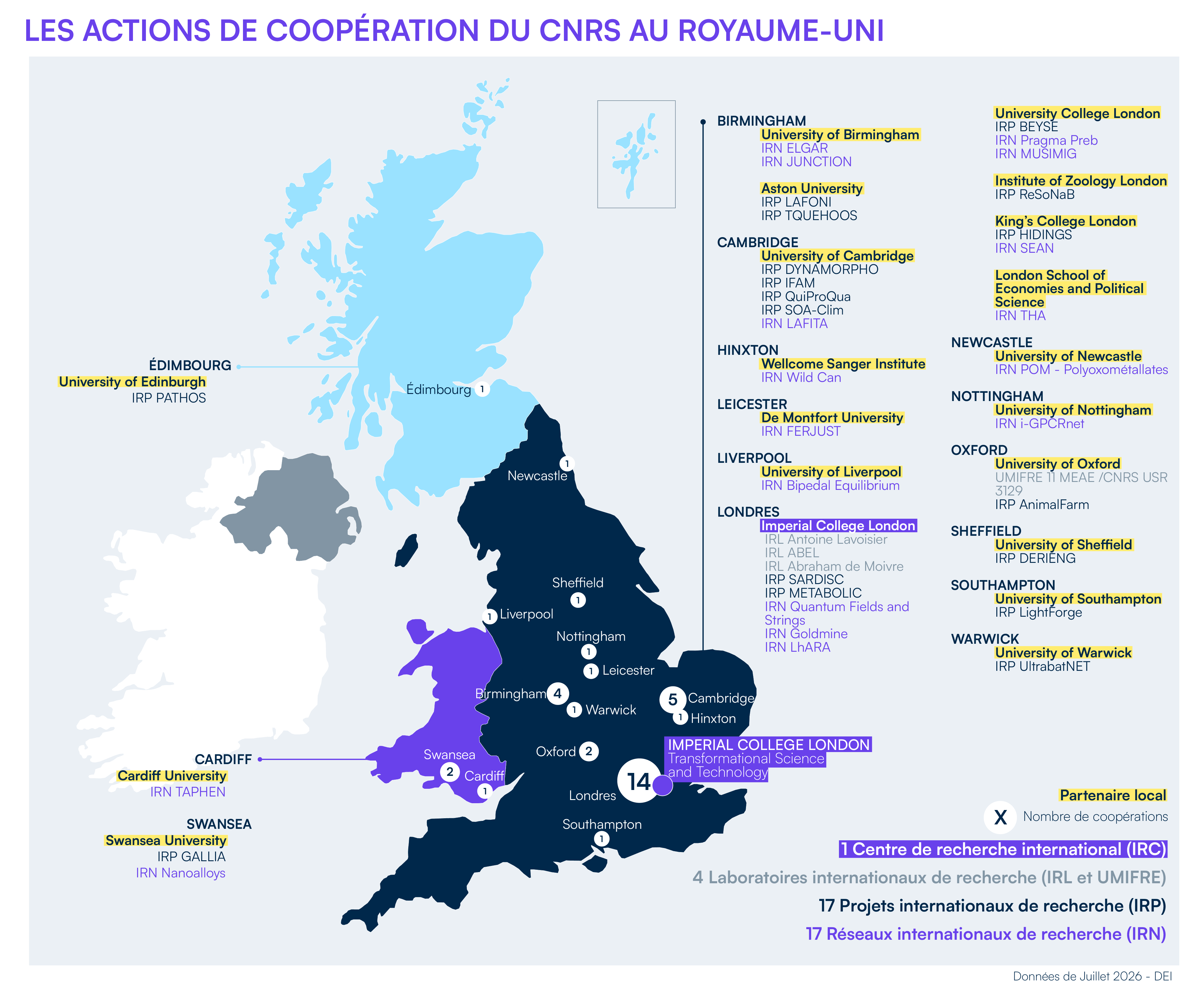
The CNRS is particularly attached to its relations with its British counterparts despite this context of political uncertainty and so has made concerted efforts to maintain them. In particular, collaboration projects with Imperial College London, one of the UK’s leading universities, have actually gained in momentum. Following on from the initial International Research Laboratory (IRL) dedicated to mathematics created in 2018, the two organisations went on to launch the PhD Joint Programmes in 2019. This scheme supported bilateral research projects through the awards of doctoral scholarships to the teams involved before the institutional partnership between the two organisations was finally formalised through the 2022 creation of an International Research Centre1.
“This agreement has facilitated exchanges and helped us forge links,” explains Sandrine Heutz, the joint scientific director of the IRC at Imperial along with her CNRS counterpart Emmanuel Brouillet. “The Joint PhD Programmes, in particular, are a unique tool for developing a new generation of young researchers who are already acclimatised to Franco-British exchanges.” Since 2019, the CNRS and Imperial have set up 35 projects and supported 70 PhD students and Alain Mermet indeed confirms that “this programme serves to embed international cooperation into the careers of young researchers.”
- 1
An International Research Centre (IRC) is an umbrella organisation with no actual physical premises. It facilitates strategic dialogue between the CNRS and a leading institution in another country, like a whole university, for example. An IRC marks a step up to a higher level and reinforces an existing relationship through projects, networks and even international laboratories, paving the way for new joint research programmes. An IRC particularly focuses on training early-career researchers through Joint PhD Programmes and on bolstering interdisciplinary work involving the different projects it manages.

Jun Han Ng, a doctoral student in the Department of Materials Science at Imperial College, is one of the young researchers participating in the joint PhD program between the CNRS and the British university © Imperial College
Since the IRC was set up in 2022, the CNRS and Imperial have been stepping up their joint collaboration initiatives, with one example being the Ayrton-Blériot Engineering Lab (ABEL) IRL created in 2025. Éric Climent is an academic working at Toulouse INP who directs the laboratory on the CNRS side. He stresses the importance of the benefits a collaboration of this kind can bring. “We can use unrivalled technical platforms and collaborate with world-class researchers. The British also appreciate our French way of working, which is particularly based on sharing equipment, and also the high calibre of our students.” The perception of these mutual benefits also helped lay the foundations for the ‘Antoine Lavoisier’ Multiscale Metabolism International Research Laboratory launched in May 2026. “Collaborations between the CNRS and Imperial show how like-minded partners can drive forward excellence in research,” adds Mary Ryan, the Vice Provost for Research and Enterprise at Imperial College London.
A recovery that remains to be confirmed
In parallel to the development of flourishing Franco-British bilateral relations, the United Kingdom is gradually re-establishing its links with the rest of Europe. In 2024, the UK joined Horizon Europe as an associated country and will rejoin the Erasmus+ student mobility programme in 2027, in a similar development. “This will represent a major improvement because currently we’re facing significant administrative hurdles for hosting our interns,” explains Éric Climent.
However, although this recovery is now clearly visible, it remains partial in nature. Between 2023 and 2024, the UK’s share of funding from the Horizon Europe programme went up from 5.8 per cent to 9.3 per cent, but performance levels remain below the peaks observed at the start of Horizon 2020. “It will take several years to rebuild networks, coordination habits and trust between partners,” predicts Patrick Nédellec.

The CNRS International Research Laboratory (IRL) Abraham de Moivre is a joint mathematics laboratory that serves as a platform for collaborations between the French and British mathematics communities.© Imperial College London
The 2028 deadline
Another deadline is raising questions, namely the European Union’s upcoming framework programme for research and innovation, FP10, which is set to succeed Horizon Europe in 2028. Negotiations are now well under way eighteen months before the transition. As the UK is no longer a member of the EU, it has no decision-making power in discussions regarding the future FP10. However, as an associated country, the UK is still eligible for nearly all European funding programmes. “When the British became an associated country in 2024, they had access to nearly 95 per cent of the calls for proposals and this proportion even went up in 2025 when the programme opened up to certain key themes like quantum technology,” notes the scientific adviser for the French Embassy in the UK.
Sandrine Heutz considers the most important objective is to pursue both bilateral and European efforts in parallel. “In the coming years, we’d like to cultivate our own bilateral relationship, for example for training or collaborations with industry, while also using the CNRS-Imperial IRC to drive applications for more international projects.” Mary Ryan shares the same ambition. “We hope the focus on excellence and international collaboration will remain a cornerstone of the new Horizon Europe programme, and that the UK plays a key role in its delivery.”
© Direction Europe et International / CNRS