

It was something of a lightning visit although rich in substance. From June 23rd to 26th, a delegation including Antoine Petit, the CNRS Chairman and CEO, Christelle Roy, director of CNRS Nuclei & Particles and Alain Mermet, director of our European and International Affairs Department (DEI), visited Beijing and Guangzhou. The trip provided the opportunity to officially launch four International Research Networks (IRN)1 . These are co-managed with the Chinese Academy of Sciences (CAS) - the country's leading scientific institution and considered among the foremost such organisations worldwide. A call for joint projects was also announced and will be run with the main funding agency for Chinese basic research, the National Natural Science Foundation of China (NSFC). The latest visit followed the October 2023 visit by three Chinese scientific delegations (the Chinese Academy of Social Sciences (CASS), the NSFC and the CAS) to CNRS headquarters. These visits testify to China's aim to bolster its cooperation with France and Europe as a whole.

"This visit marks an important stage in relaunching and strengthening our scientific collaborations with China. These are often long-standing collaboration projects whose dynamism has been severely affected by the Covid crisis. The major challenges of our era and the place China now occupies on the world scientific stage both make it important to revitalise our partnerships with top-level partner institutions like the Chinese Academy of Sciences and the National Natural Science Foundation of China", explains Alain Mermet.
Forty years of scientific collaboration
French and Chinese scientists have been collaborating on research into earthquakes and other telluric hazards since the 1980s. Stéphane Guillot, the scientific delegate for sustainable development and risks delegate at the CNRS Scientific Office (DGDS), points out that this cooperation has helped develop a robust culture of scientific exchanges between the two countries, particularly in seismology and Earth dynamics: "Franco-Chinese collaborative research into telluric risks and particularly earthquakes goes back to the1980s and China opening up which French teams were among the first to react to", he explains. This cooperation between China and France has helped create a culture for scientific exchange, particularly in seismology and tectonics as China is a prime zone for such research. "The territory of Tibet is where the Indian plate meets the Asian plate with a convergence of 5 cms each year. This shortening is accommodated by major faults across the Tibetan plateau and regularly causes powerful earthquakes. The absence of dense vegetation means researchers can clearly observe geological structures, making their work much easier," explains the researcher.
Various historic projects have also helped structure this collaboration, such as work at the Institut de Physique du Globe de Paris2 which have notably involved French researchers like the geophysicist Paul Tapponnier and the tectonist Yann Klinger. The latter was recently awarded an ERC grant for his work on the characterisation of major earthquakes. The evolution of China's continental structure over a 300 million years has also been the subject of research by teams from the Earth Sciences Institute of Orléans3 (ISTO). Finally, the Beijing Institute of Geology and Geophysics (CAS), the Grenoble Institute of Earth Sciences4 and Italian universities have been collaborating on geophysical imaging studies in the Alps since 2014.
"Risks linked to climate change represent a whole new challenge for Franco-Chinese collaborative research", explains Stéphane Guillot. China is heavily affected by natural disasters like mudslides and floods. The country is also facing an increase in the combination of natural hazards like storms or rising sea levels and human vulnerability (population density and infrastructure in previously uninhabited areas). To provide effective responses to these challenges it is crucial to reconcile studies on hazards and vulnerability. Exchanges have resumed since Covid which is a clear opportunity to reinforce these collaborations. "The recent visits to CNRS headquarters by Chinese delegations illustrate this renewed desire to collaborate on these vital issues," he adds.
During the recent visit to China a call for joint projects working on these two themes was launched by the CNRS and the NSFC to further strengthen Franco-Chinese cooperation on risks and biodiversity. The call will provide funding for up to five collaborative projects involving French and Chinese researchers. The overall aim is of course to work effectively together to tackle these major environmental challenges.
International research networks: knowledge-sharing tools
In October 2023, the CNRS and CAS defined four priority areas for cooperation when their agreement was renewed - particle physics, mathematics, biodiversity and the impact of climate change, and ocean research. In the wake of this agreement, the CNRS officially launched four International Research Networks (IRN) during the delegation's visit to China. These focus on applied mathematics, particle physics and biodiversity.
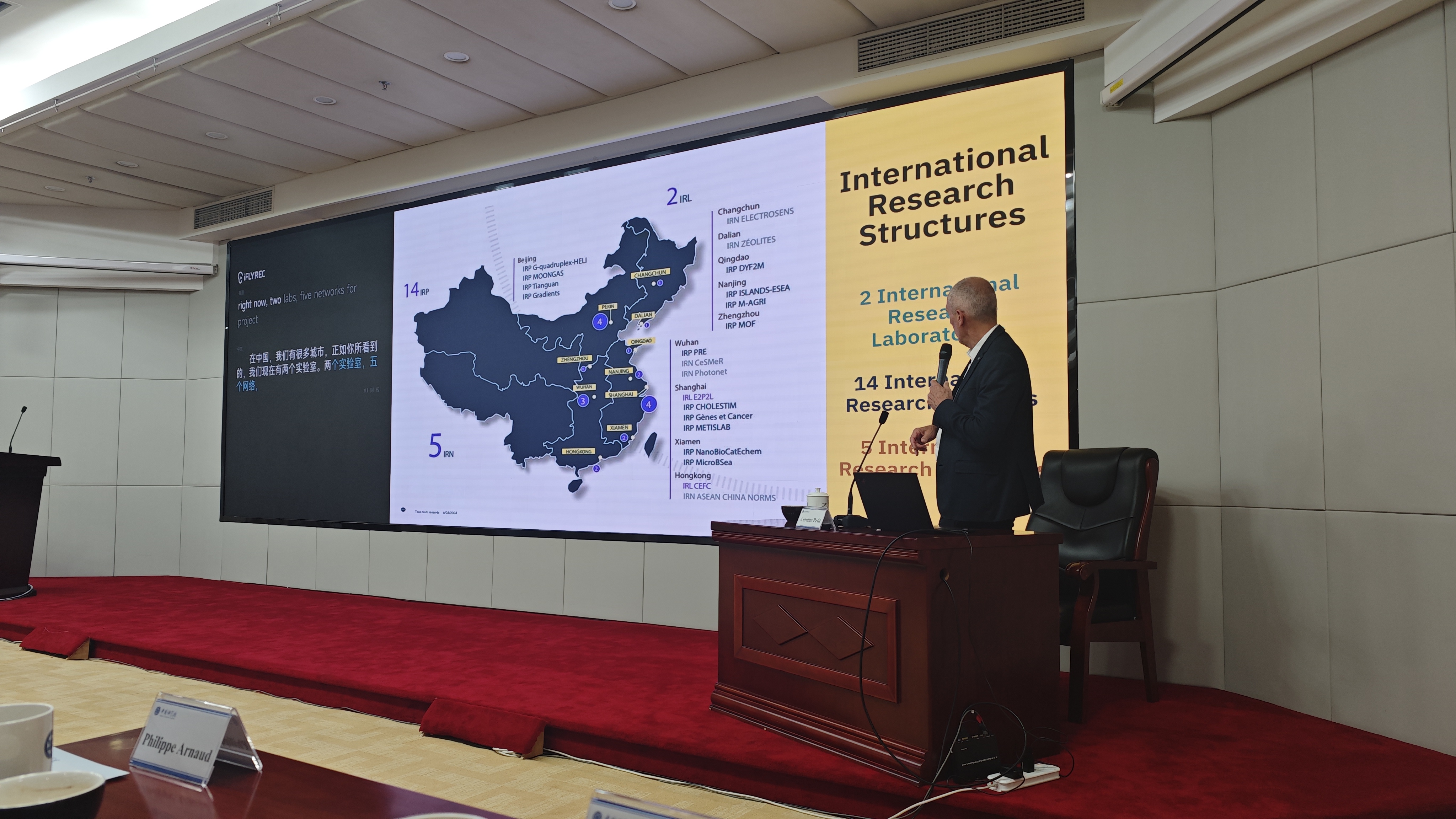
Magali Profitt, the coordinator of the International Biodiversity Research Network, explains that "challenges like climate change, the extinction of species and the emergence of diseases make international cooperation ever more crucial. Tools like IRNs bring together French and Chinese researchers to work on environmental issues like these." This IRN was initiated by Martine Hossaert-McKey and Yvon Le Maho and supported by around fifteen partners in France and China. Its aim is to connect specialist biodiversity researchers. This initiative will foster exchanges of the knowledge built up by the two countries and places particular emphasis on ecosystem preservation solutions. "One of the IRN's objectives is training. The programme initially focused on Chinese students but now French students are included", she adds. Alain Mermet explains that "one important aspect of this renewed cooperation is that it encourages young French researchers to travel to China more so as to gain better understanding of a now world-class research ecosystem. The cooperation schemes run by the CNRS provide the right framework for mobility of this kind."
Parallels between the Mediterranean and certain Chinese regions
Robust foundations underpin Franco-Chinese collaboration on biodiversity, with some projects existing for several decades now. "Comparative approaches are justified by the similarities between certain ecosystems in our two countries like interactions between plants and pollinators and the high atmospheric pollution levels found in the Mediterranean and certain regions of China," adds Magali Proffit. Researchers are also working on zoonotic subjects like the risks linked to the presence of brown rats in major cities. "This species proliferates in both China and France which makes running in-depth comparative studies possible. Similarly, the loss of biodiversity in agricultural environments highlights our shared concerns for subjects like the decline of the European hamster in France and similar species in China,," explains Caroline Habold, the network's co-coordinator alongside Magali Proffit. The launch of the new IRN will formalise these collaboration projects and hopefully stabilise and strengthen them. The IRN will promote theoretical exchanges and benefit from dedicated funding to secure long-term cooperation with the ultimate aim of creating an international research laboratory.
Antoine Petit's visit to China also gave the Chairman and CEO the opportunity to visit the facilities of the JUNO neutrino detector (see box) scheduled to be officially launched at the end of 2024. JUNO is the fruit of international cooperation led by the CAS and involving CNRS Nuclei & Particles laboratories since the project's launch a decade ago.
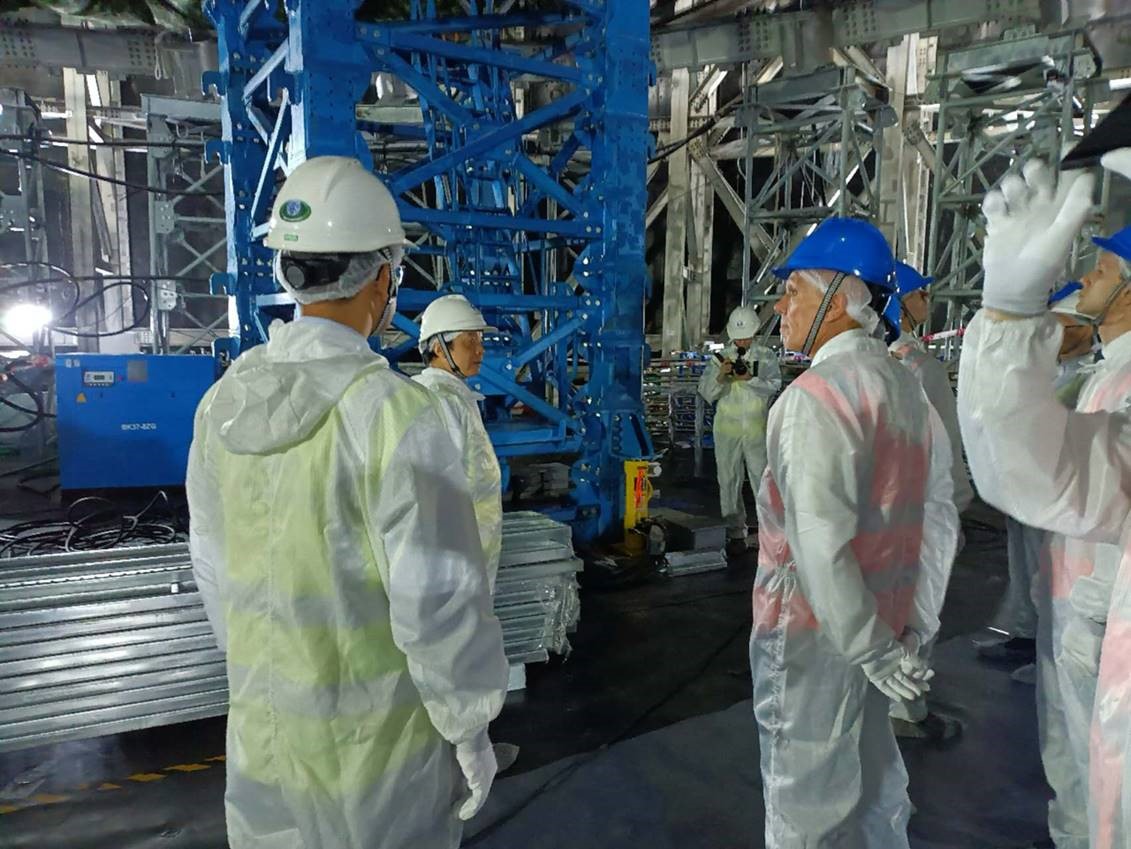
The upcoming JUNO facility testifies to China's desire to position itself as one of the world leaders in cutting-edge research. The signature of four agreements for IRNs during the visit is a clear sign of the CNRS's determination to strengthen its collaborations with leading research institutions in China.
- 1International Research Networks (IRNs) are cooperation tools that help structure an international scientific community. They are made up of one or more French laboratories, including at least one from the CNRS, and several laboratories in other countries who work together on a shared theme or within a research infrastructure.
- 2CNRS/Institut de Physique du Globe de Paris.
- 3BRGM (the French geological survey) /CNRS/University of Orléans.
- 4Université Grenoble Alpes / Université Savoie Mont-Blanc/ Université Gustave Eiffel /CNRS/IRD