
CatFoam project
Creating structured fluids with active enzymes to degrade bacterial biofilms or microplastics
Impact
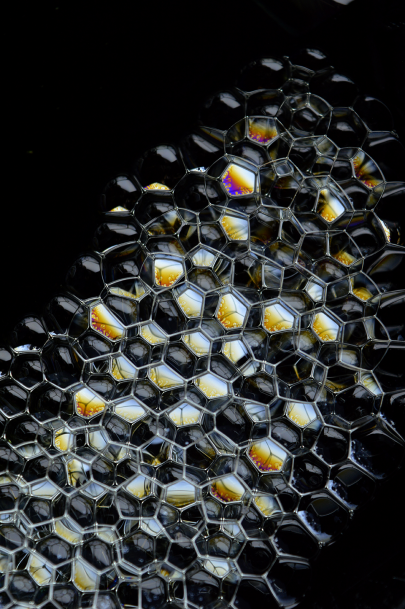
CatFoam combines the science of physics and biochemistry to innovate in enzyme catalysis. Enzymes are renowned for their efficiency and specificity in green chemistry and catalyse reactions under mild conditions (pH, temperature). Enzymes are traditionally attached to solid supports but this approach has been found to sometimes reduce their efficiency and adaptability. Conversely, structured fluids like foams and emulsions possess a unique internal structure that gives them remarkable physical properties. The CatFoam project's objective is to take advantage of this structure by incorporating enzymes therein to thus create fluids capable of capturing and breaking down harmful substances.
The combination of these two ingredients is the innovation. CatFoam works simultaneously on a nanometric and macroscopic scale. In exploiting the properties of liquid interfaces to develop innovative functionalities for structured fluids, it will pave the way for new industrial and environmental applications.
Limitations to overcome
The first challenge for the project will be to identify the enzymes or combinations thereof which are the most capable of endowing structured fluids with functional properties. The sensitivity of enzymes to their environment makes it essential for the project to find out more about how they function within structured fluids. The enzymes and their reaction products also need to be prevented from affecting the stability and flow properties of the fluid. Finally, it will be crucial to establish a coupling between the enzymes' (bio)chemical properties and the fluids' physical behaviour to optimise their combined performance.
Risks
The main risks include the enzymes being denatured by the fluid and the enzymatic action having a negative impact on the stability of the structured fluid.
Innovation potential
The main objective of the CatFoam project is to demonstrate the potential of structured fluids as specific reaction media through study of their unique physical properties. The concept can be applied to a variety of fields but CatFoam will focus on major environmental and health issues. Key objectives will be to eliminate bacterial clusters (bacterial biofilms) which are responsible for increased antibiotic resistance in hospital environments and to protect the environment through the capture and degradation of (micro)plastics.
Project leaders
- Wiebke Drenckhan, CNRS research professor, Institute Charles Sadron (ICS - CNRS)
- Christophe Chassenieux, professor at the Le Mans University, Institute of Molecules and Materials of Le Mans (IMMM - CNRS/Le Mans University)
- Fouzia Boulmedais, CNRS research professor, Institute Charles Sadron (ICS - CNRS)
- Jean Farago, professor at the University of Strasbourg, Institute Charles Sadron (ICS - CNRS)