

PheroInnov project
Innovating in agro-ecology and in counterterrorism measures thanks to the bio-inspired detection of odours by insects.
Impact
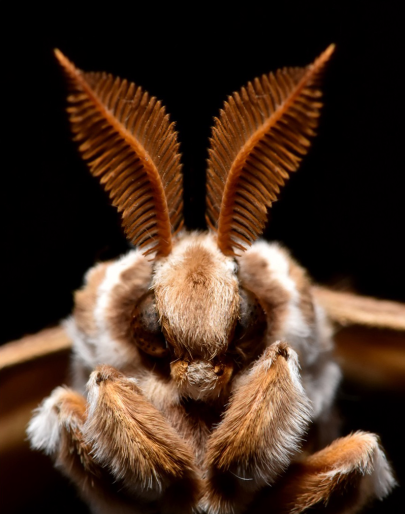
Certain animals possess the unique ability to detect just a few molecules present in m3 of air. For example, dogs are well-known to be superior to humans for this but insects are even better. Insects have to detect pheromones in infinitesimal quantities for reproduction purposes. The silkworm butterfly is of particular interest because it is capable of detecting a pheromone molecule in 1 m3 of air. This is probably thanks to the complex airflows generated by its multi-scale antennae.
From a scientific standpoint, certain stages of olfaction are already well understood particularly those that take place during long-distance orientation (macro-scale) or once the molecules have attached themselves to the receptors (micro-scale). Conversely, the upstream mechanisms of olfaction remain virtually unknown, from their emission from pheromone glands to the transport of odour (pheromones, in this case) by aerosols and then to the processes from the point of capture of the odorant to the olfactory pore (mesoscale).
Limitations to overcome
The two barriers that have been identified are both scale issues. The principle obstacle is the change in scale between organs of the order of 1 cm (antenna) and structures of 10 cm to 1 m required for the planned applications. This means that the laws of aerodynamics are particularly important and change according to the scale involved. 3D printing of architecturally complex structures (insect antennae) made up of elements of up to 4 orders of magnitude (from a 5 micrometer sensilla to a 2 cm antenna) is a secondary research challenge deriving from the multi-scale geometry of biological objects.
Risks
Several major breakthroughs in the project have been identified because of the possible impact of a proof of aerosol transport. Consequently, the current dogma by which a single molecule induces a nerve impulse has to be revisited and the construction of an active nose that enables enhanced capture opens up a new field of technological possibilities.
Innovation potential
This project could lead to bioinspired implementation in two impactful fields of application. In agro-ecology, it will be possible to fight invasive pest species (estimated to cost at least $70 billion per year) by using bio-inspired dispensers to improve the emission of pheromones. The objective will be to emit sex pheromones at lower concentrations thus bringing down the cost of this biological control measure and facilitating market penetration. Until now large quantities have been used with limited effect because of gaps in our understanding of the diffusion process. Also, in the fight against terrorism this will enable scientists to innovate in the detection of explosives and anti-personnel mines which cause around 5000 deaths and injuries a year worldwide currently, with the figure rising. The creation of new more sensitive and quicker noses for robots will integrate active olfactory mechanisms to facilitate the capture of molecules of very low volatility with an application in the search for explosives.
Project leader
Jérôme Casas, professor at the University of Tours, Insect Biology Research Institute (IRBI - CNRS/University of Tours)