
Human neuronal networks for modelizing Parkinson’s disease
Health
Aggregation of the alpha-synuclein protein is involved in neurodegeneration in Parkinson’s disease. By using human stem cells differentiated into nerve cells, researchers from the CNRS and Inserm have just shown that alpha-synuclein aggregates propagate from one neuron to another. This discovery made on human neuronal networks could help develop new therapeutic strategies to prevent increased alpha-synuclein aggregation and the degeneration of neurons. The study is published on January 10, 2019 in the journal Stem Cell Reports.
Research published in 20151 showed that altered and aggregated forms of the alpha-synuclein protein increased in the brains of rodents, and caused various Parkinsonian symptoms.
In this new study, researchers2 used human pluripotent stem cells, differentiated them into neurons, and designed a simplified and robust neuronal network typical of the human brain. They then exposed these neurons to altered forms of alpha-synuclein, and observed the appearance of pathological signs characteristic of Parkinson’s disease and multiple system atrophy (MSA), another neurodegenerative disease. Alpha-synuclein actually aggregates differently for each of these diseases, thereby forming a “signature” of each one.
The scientists also showed that “sick” neurons transfer altered alpha-synuclein to healthy neurons, particularly through synaptic connections. By passing from neuron to neuron and multiplying in similar fashion to the infectious protein prion, the altered forms of alpha-synuclein affect the integrity and function of the neuronal network.
The researchers’ new model of neuronal network derived from human stem cells will enable the study of new molecules that can target the altered forms of alpha-synuclein and prevent their propagation and subsequent neuronal degeneration. In studying “signatures” for Parkinson’s disease and MSA, this research could also improve the screening for these illnesses.
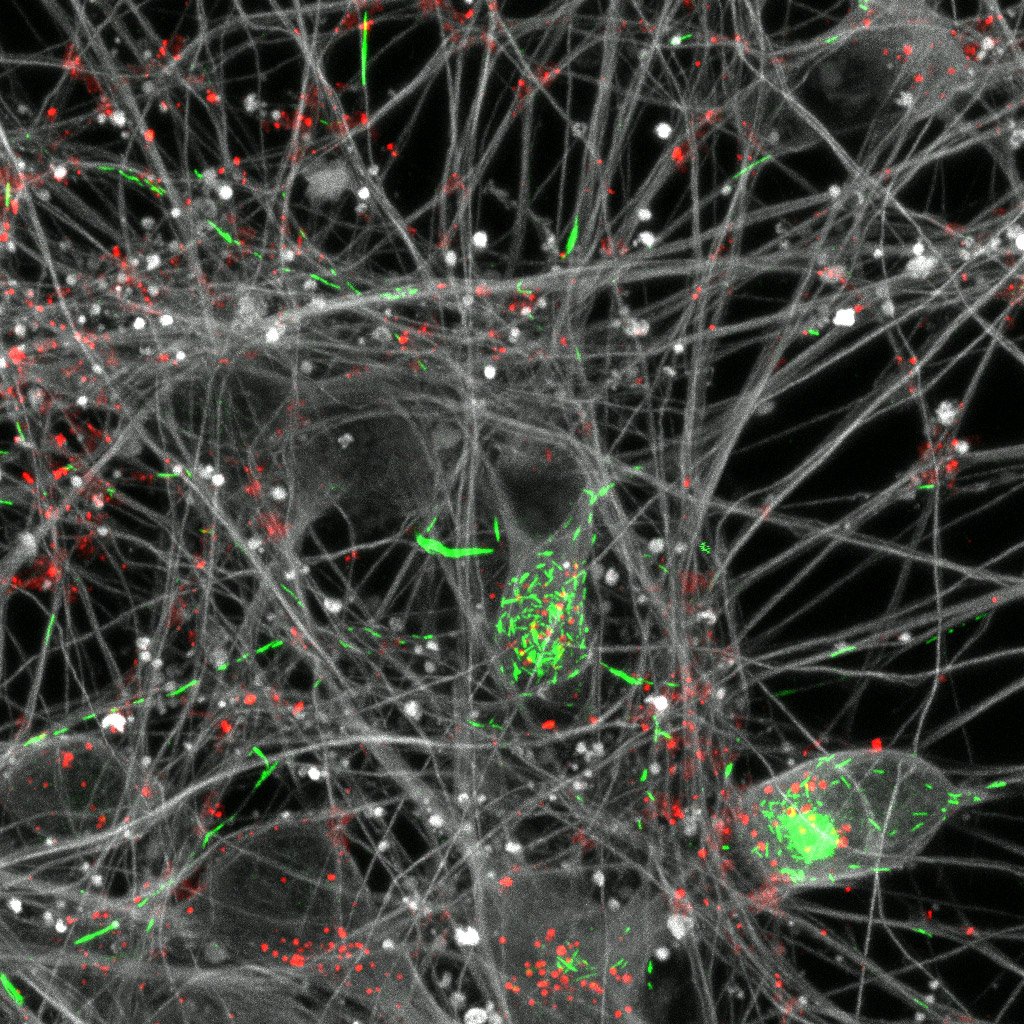
© Simona Gribaudo, Stem Cell Reports
- 1Press release from June 10, 2015: http://www2.cnrs.fr/presse/communique/4077.htm
- 2Researchers from l’Institut des Cellules Souches pour le traitement et l'étude des maladies monogéniques (Inserm/Université d’Evry Val d’Essonne/AFM), the Laboratoire de maladies neurodégénératives (CNRS/CEA/Université Paris-Sud), as well as the laboratories Adaptation Biologique et Vieillissement (CNRS/Sorbonne Université) and Neurosciences Paris-Seine (CNRS/Inserm/Sorbonne Université), both of which are part of l’Institut de Biologie de Paris-Seine.
Bibliography
Propagation of α-Synuclein strains within human reconstructed neuronal network. Simona Gribaudo, Philippe Tixador, Luc Bousset, Alexis Fenyi, Patricia Lino, Ronald Melki, Jean-Michel Peyrin, Anselme Louis Perrier, Stem Cell Reports, January 10, 2019.
Contact
Ronald Melki
CNRS researcher
Jean-Michel Peyrin
CNRS researcher
Anselme Perrier
Inserm researcher
Julie Desriac
Press officer