


Overseas commercial ports - exceptional geostrategic locations undergoing transition
The idea of a 'sentinel port' capable of alerting and guiding its territory is emerging in overseas ports finding themselves at the crossroads between various geostrategic issues. This approach is driving research projects co-developed by the CNRS with its university partners and local stakeholders.
The port of the future will be vital for overseas territories but what will form will it take? "Almost everything comes in and out through ports - oil supplies, consumer goods, food, exports, and so on," says Jean-Raphaël Gros-Désormeaux, director of the Powers, History, Slavery, Atlantic Caribbean Environment Laboratory
The desire for ports to establish themselves as a 'sentinels' capable of anticipating economic, social and environmental issues emerged during workshops with Martinique's inhabitants. These were conducted by the PHEEAC research laboratory under the joint supervision of the CNRS and the Université des Antilles as requested by the Grand Port Maritime de la Martinique. "The port possesses a wealth of data and observations that are useful for the region. Some involve economic issues and some environmental issues like the presence of potential pollutants or invasive alien species," explains Jean-Raphaël Gros-Désormeaux.
Structured research with the Martinique's Grand Port Maritime
Modernisation projects are ongoing in the ports themselves which need to be able to anticipate local, regional and global dynamics. The Grands Ports Maritimes de la Guadeloupe (GPMG) and Grands Ports Maritimes de la Martinique (GPMLM) are both public entities that are core elements of the Hub Antilles
The Grand Port Maritime de la Martinique has teamed up with scientists to launch its own transformation so they can draw on a comprehensive and impartial vision provided by science. It formalised its links in an agreement signed in June 2025 with the CNRS and the Université des Antilles. "We're carrying out a broad review to structure scientific research with the port," explains Aymeric Barlet, the GPMLM's head of industry and energy responsible for steering issues linked to biodiversity and environmental challenges. The CNRS has given a tangible form to this partnership with the creation of the Observatoire de la Transition Socio-Écologique Portuaire
This partnership has three main focus areas. The first is 'territorial governance' and indeed the CNRS, as public research organisation, would like to establish itself as a trusted stakeholder that listens to both users and its territory. "Scientific research, particularly in the humanities and social sciences, informs our governance. It's a way of opening up to our territory," explains Aymeric Barlet.
"Becoming an influencer for the socio-ecological transition"
The concept of the 'sentinel port' emerged in this framework. Several residents mentioned this idea during the first of the PHEEAC's 'socio-ecological transition workshops' on subjects like energy and biodiversity. Gradually, these workshops will focus on other themes with the aim of finding out "how the port, a major stakeholder in the region, can become an influencer for the socio-ecological transition," adds Jean-Raphaël Gros-Désormeaux, the PHEEAC's director.
The other focus areas are intended to help the port develop this role as a 'sentinel' that collects and shares useful information for its territory. The second focus is on experiments, with scientific supervision provided by the PHEEAC. An example is the Lab'ô Coraux research laboratory specialising in corals with joint funding from the GPMLM and the CNRS. This laboratory is already working to accelerate the regrowth of corals that will be moved in the framework of the expansion of the GPMLM container terminal at Pointe des Grives. The laboratory will work on assessing the effects of this initiative and finding out more about the resilience of corals that grow on port infrastructure.

The laboratory's work is part of the port's compensation measures, which are mandatory for projects subject to environmental investigation, after having demonstrated that efforts have been made to avoid and reduce environmental impacts. Aymeric Barlet emphasises the fact that "the scientific approach provides credibility for our environmental authorisation applications. We're investing heavily in this laboratory, which has been designed as a tool for managing compensatory measures that can be used by the port's other infrastructure projects."
"Developing solutions jointly between researchers, employees and users"
The third focus area for work is global change. The CNRS (with PHEEAC), Météo-France and GPMLM are to carry out a multidisciplinary study of the effects of heat waves in the port, which is a veritable heat island. Port employees and users are experiencing increasingly intense and frequent heat waves. The research will be used by the local authorities to define risk indicators and will also form the basis of the port's resilience strategy. "We'd like to develop solutions jointly between researchers, employees and users. These may be architectural in nature – like greening – or even social solutions related to the organisation of work," explains Aymeric Barlet.
Beyond the joint actions with the GPMLM, the research carried out by the CNRS and its scientific partners is also intended to feed into the decision-making process of overseas ports. "Everything's linked. We need to satisfy the ports, the companies that operate there and the local economies while also taking geopolitical risks into account, protecting the environment, and so on," explains Colette Ranély Vergé-Dépré, a member of the board of directors of the Observatoire Hommes Milieux (OHM)
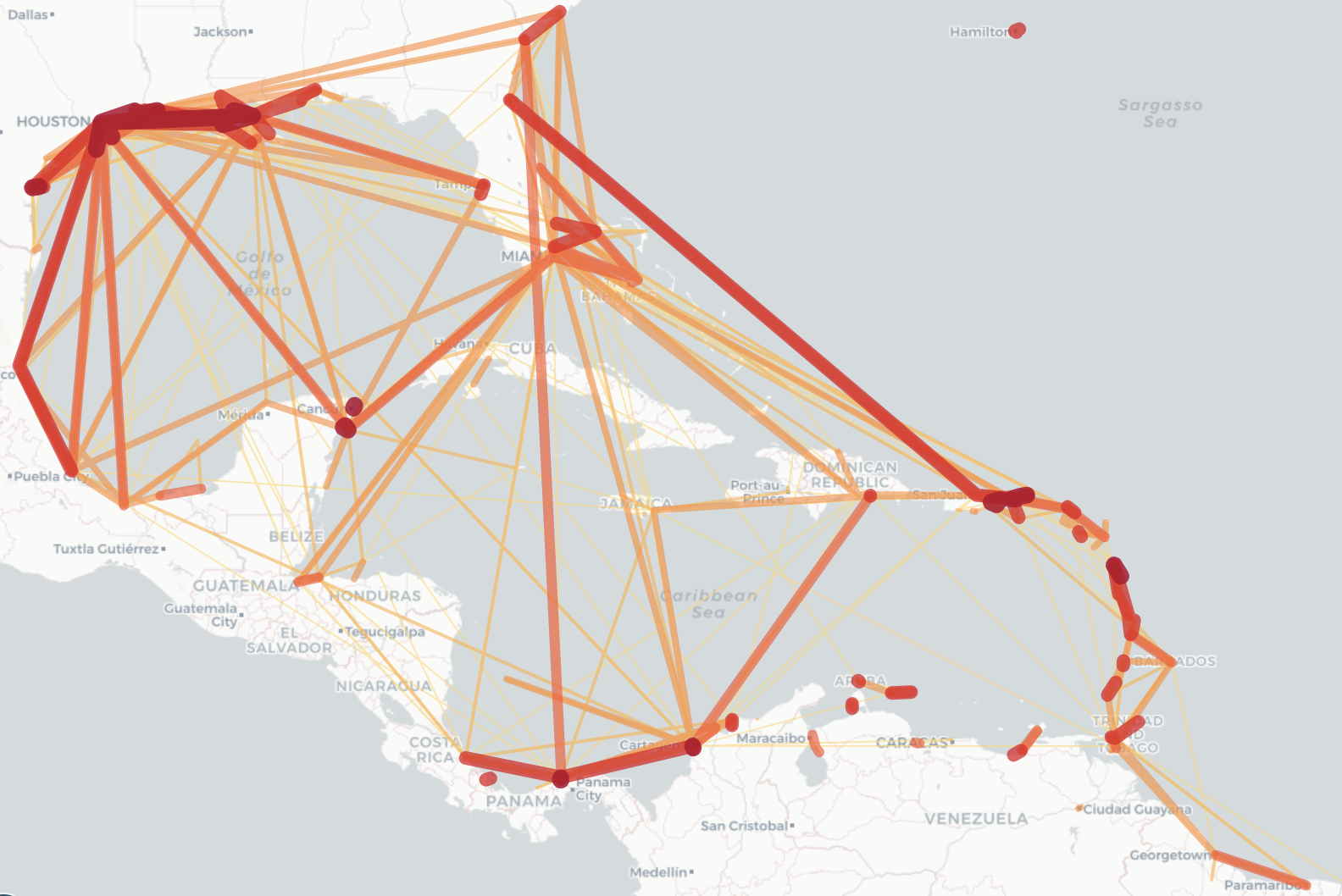
The OHM Littoral Caraïbe has developed interactive visualisations of maritime traffic and networks in the Caribbean region to support the decision-making process in the framework of the TRAFIC project
Imagining alternatives to the "logic of volume"
Currently the transhipment model – the exchange of containers between ships of different sizes without goods entering a territory – contributes to "infrastructural inflation or, in other terms, an increase in the size of ships and infrastructure," explains Éric Foulquier. This model has also brought up questions about the extent of the economic benefits for the territory in comparison with its environmental impacts. Researchers are analysing the causes and effects of this model at all scales, including the global scale.
The researcher goes on to explain that "we're also conducting research on value chains," to identify relevant alternatives and thus promote a shift from relying solely on the "logic of volume." Among such ideas are the circular economy, which could be industrialised, and even environmentally friendly initiatives like hosting sailing cargo ships, which currently remain residual in nature.
"We have a place to find in the regional economy, particularly through niche markets. We need to aim for excellence to justify the higher prices linked to our membership of the European Union. For example, the Guadeloupe's Grand Port Maritime is working on advanced data automation services," confirms Colette Ranély Vergé-Dépré. These challenges are shared by France's four major overseas ports in Guadeloupe, Martinique, French Guiana and Réunion.
The CNRS's work on the issue of silting in French Guiana
Maritime traffic in French Guiana is increasing along with the growth of French Guiana's population. And yet, "sediment deposits from the Amazon River periodically restrict access to ports. Mud banks are forming along the coast of French Guiana and silting up access routes," explains Antoine Gardel, director of the Ecology, Evolution, Interactions of Amazonian Systems in French Guiana Laboratory (LEEISA)
The CNRS has been working for a long time with the Grand Port Maritime de Guyane (GPMP, also known as Dégrad des Cannes) to help it carry out dredging operations to remove silt. The latest project to date is a partnership for the acquisition of real-time data with the GPMG, France's Directorate-General for Territories and the Sea and the French Geological Survey (BRGM). A dedicated oceanographic buoy has been installed near the port to record data on currents, swells and water turbidity