Fossilised vomit reveals the diet of dinosaur predecessors
Earth
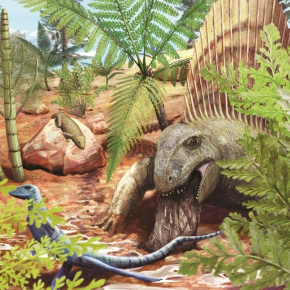
At the Bromacker fossil site in Germany, an international team including a CNRS scientist1 has identified the oldest terrestrial fossilised vomit known so far. Dated to around 290 million years ago (Early Permian), several tens of millions of years before dinosaurs appeared, this fossilised vomit, or “regurgitalite,” contains numerous partially digested bone fragments, including those of two small reptiles and an amphibian2, preserved in a phosphate-poor matrix3. Analyses of these remains suggest that this regurgitalite can be attributed to a superpredator with an opportunistic diet, Dimetrodon or Tambacarnifex, two “mammal-like reptiles”4 that once inhabited this site.
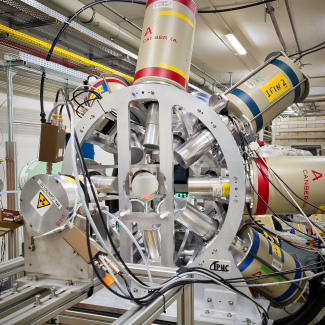
These findings, to be published on January 30th in Scientific Reports, are based on a meticulous description of each fragment obtained through 3D scanning using X-ray microtomography5, combined with a geochemical analysis of the matrix, and of the Early Permian fauna from Bromacker.
Remarkably well preserved, this rare fossil is among the few regurgitalites identified to date. In addition to providing direct evidence of the feeding habits of the species that produced it, it provides new insights into trophic networks, and more broadly into the functioning of terrestrial ecosystems prior to the emergence of dinosaurs.
- 1From the Center for Research on Palaeontology, Paris (CNRS/MNHN/Sorbonne Université).
- 2The two identified reptiles, one quadrupedal and the other bipedal, belong respectively to the genera Thuringothyris and Eudibamus. The amphibian is a diadectid.
- 3The sediment or rock surrounding a fossil in which it is embedded. The matrix can contain microfossils, chemical traces, and other clues that help reconstruct the environment and ecosystem in which the organism lived.
- 4Belonging to the synapsid group, vertebrates characterised by the presence of a single temporal fenestra on each side of the skull.
- 5X-ray microtomography is an imaging technique that makes it possible to observe the interior of a fossil in three dimensions without damaging it. It uses X-rays to reveal structures invisible to the naked eye, such as bones or mineralised tissues still trapped in the rock.
Bibliography
Early Permian terrestrial apex predator regurgitalite indicates opportunistic feeding behaviour Arnaud Rebillard, Andréas Jannel, Lorenzo Marchetti, Mark J. MacDougall, Christopher Hamann, J.-Sébastien Steyer, Jörg Fröbisch. Scientific Reports, 30 January 2026.
DOI: 10.1038/s41598-025-33381-0