
The waltz of fermions under the microscope
Matter
Superconducting materials transport current with no heat dissipation1, a property partly explained, according to the Bardeen-Cooper-Schrieffer theory, by the formation of electron pairs2. A better understanding of this mechanism would help explain the inner workings of certain “high critical temperature” superconductors3. One approach to explore this kind of phenomena is to perform quantum simulations, by manipulating neutral fermionic atoms that interact attractively (the minimal ingredients of superconductivity theory) in well-controlled experiments. Scientists working as part of an international collaboration led by a CNRS team4 and ENS-PSL have, for the first time, shown that fermions are not simply pairing within these systems: they also repel other neighbouring particle couples, like dancing couples keeping distance from each other in a ballroom. This dual pairing phenomenon was demonstrated in a study published in Physical Review Letters on April, 15th.
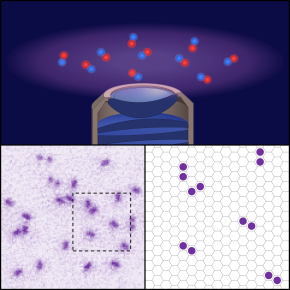
To identify this fermionic behaviour, the scientists used a continuum quantum gas microscope, a technique developed at CNRS5 that can “photograph” matter at the atomic scale. By cooling lithium atoms – which are fermions – down to temperatures approaching absolute zero, the team was able to observe each particle, and to then reconstruct their spatial arrangement, which they compared to advanced numerical calculations.
This research establishes new avenues to better understand complex quantum properties that could eventually guide industrial actors in designing more efficient superconducting devices.
- 1Unlike other conductive materials, this property of superconductors allows for reduction of energy use in connection to cooling and transport in electrical systems, which are a source of pollution.
- 2Electrons are fermions, which along with bosons are one of the two major categories of elementary particles.
- 3High critical temperature superconductors differ from low critical temperature superconductors in that they remain conductive without resistance at much higher temperatures, thereby making them easier to use, and paving the way for technologies such as cables or devices that transport electricity without producing heat.
- 4From the Kastler Brossel Laboratory (CNRS/Collège de France/ENS – PSL/Sorbonne Université). Other scientists from the Collision Agrégats Réactivité Laboratory (CNRS/Université de Toulouse) were also involved.
- 5This method was developed in earlier research conducted by the team of Tarik Yefsah, CNRS researcher at Kastler Brossel.
Bibliography
Observing Spatial Charge and Spin Correlations in a Strongly-Interacting Fermi Gas. Cyprien Daix, Maxime Dixmerias, Yuan-Yao He, Joris Verstraten, Tim de Jongh, Bruno Peaudecerf, Shiwei Zhang, Tarik Yefsah, Physical Review Letters, April, 15th 2026.