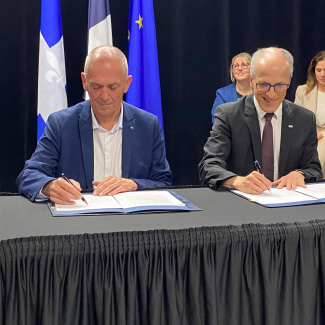
The CNRS and the FAPESP have signed a Franco-Brazilian collaboration agreement
Corporate
A new agreement has been signed by the CNRS and the São Paulo Research Foundation (FAPESP), one of Brazil's leading research funding agencies. This paves the way for new scientific cooperation initiatives in the region. Here we discuss the motivations driving this collaboration and its likely impact with the FAPESP's administrative director, Fernando Menezes de Almeida.
In the agreement signed at the March 27th inauguration of the Maison du CNRS at the University of São Paulo (USP), the FAPESP
Fernando Menezes de Almeida
The FAPESP has exclusive tools that are generally reserved for research institutions linked to the State of São Paulo with limitations depending on the institution a researcher is attached to. For this new agreement, we decided to extend this opportunity to CNRS researchers working at the IRC and consider them as State of São Paulo researchers.
Could you give us some details of these financial mechanisms and their budget of over 5 million euros?
F. M.A.: The FAPESP allocates this sum of more than 5 million euros to the University of São Paulo in the framework of the IRC partnership. Researchers can apply for FAPESP funding as the IRC is considered a budget priority. The projects funded may exceed this initial amount. The FAPESP's funding is organised into different budget lines, with projects lasting from one to ten years. Funding can range from a few hundred thousand to tens of millions of euros according to the scale of the projects involved. Now we have opened up access to all FAPESP tools to CNRS researchers working for the IRC.
Our financial mechanisms include study grants at all levels (degree, master's, PhD, post-doctorate) and funding for research projects to cover laboratory equipment and operations, scientific meetings, publications or travel. Various types of grants are available and are designed to bolster research in Brazil and foster international collaboration, particularly with the CNRS.
We also offer financial support grants, particularly the 'young researcher' grant, a kind of enhanced post-doctorate grant adapted to the cost of living in Brazil, and also specific funding for laboratories to be set up. The objective is to attract researchers to start up new lines of research even if they do not yet have institutional links with the USP or another São Paulo research institution. If researchers are already employed by another institution, this funding can be attributed without the grant component. This is one example but there are others, including PhD student mobility calls and many more.
Could you tell us some more about the South Atlantic Ocean and Antarctic (PROASA) programme and how it bolsters Franco-Brazilian scientific cooperation?
F. M.A.: The close collaboration between France and Brazil in recent years – particularly between the CNRS and the FAPESP - has led to the ambitious PROASA project aimed at gathering new knowledge on the South Atlantic and Antarctic. The South Atlantic is a fruitful region for scientific research but has been the subject of far less exploration and studies than the North Atlantic. France is active in Antarctica and Brazil is also showing a keen interest in the region. The University of São Paulo's research structures are robust and the FAPESP is strongly committed to this field, having even funded the USP's oceanographic vessel to explore the South Atlantic.
On the same theme and in parallel, the CNRS is a major stakeholder in the creation of the Intergovernmental Panel for Ocean Sciences (IPOS). In April 2023, the organisation invited 15 research institutions - including the FAPESP and the University of São Paulo - to Brussels to form a coalition. Its aim is to foster crucial political support from the United Nations for the creation of the IPOS. In this context the United Nations Ocean Conference in June 2025 is very much a key date.
These two initiatives highlight the joint efforts made by the CNRS, the FAPESP and the USP on the ocean research theme. Of course oceanographic exploration is one of the IRC's seven main research themes
What do you think about the CNRS's Brazil Office moving to the Maison du CNRS in São Paulo?
F. M.A.: We see the CNRS Office's move to São Paulo as very important strategically and as recognition of the strength of our partnership, particularly in the framework of the IRC. It is the result of fruitful and coherent collaborative work by our two institutions. The move will drive a new stage in our collaboration and further intensify our shared interest in scientific research.