Innovation in the humanities and social sciences – from cybersecurity to educational games
Rencontres Innov'SHS, the flagship event for CNRS Humanities & Social Sciences, will take place at the Maison de l'Amérique Latine in Paris on October 9th. This is the perfect opportunity to find out how the humanities and social sciences are innovating in a wide range of fields, sometimes even in most unexpected areas. And for the first time, the prize for innovation in the humanities and social sciences will be awarded at this event.
Emilie Bonnefoy still finds it surprising. "Combining cognition and cybersecurity isn't all that frequent. And yet, to our surprise we got a good number of responses from research laboratories to the survey we asked the CNRS Business Relations Department (DRE) to run". Maria Teresa Pontois, head of innovation, technology transfer and industrial partnerships at CNRS Humanities and Social Sciences, confirms the humanities and social sciences' interest for cybersecurity and the role these sciences play. "They are true providers of solutions in this area".
On October 9th, we will be able to find out the extent to which this is the case during a round table on the subject during the first Rencontres Innov'SHS at the Maison de l'Amérique Latine in Paris. The new event follows on from five editions of the Innovatives SHS fair set up in 2013 by Patrice Bourdelais, then director of the CNRS Institute for Humanities and Social Sciences, now CNRS Humanities & Social Sciences. This year's event will focus on two main areas "where you might not have expected the humanities and social sciences but where we've been successfully proactive", comments Maria Teresa Pontois. A total of six themes will be covered by the round tables this year.

The humanities and social sciences' essential insights into the human and social sides of cybersecurity
In cybersecurity, input from the humanities and social sciences is particularly sought after on "the human and social aspects that are lacking in this sector which mainly just focused on technology for years now", explains Emilie Bonnefoy, a tinge regretfully. "We need to know about the human brain and how individuals perceive safety in their own context and with their own specificities. That's where the social sciences and humanities come in by shedding light on technology in a complementary way". This company director goes on to explain her idea in more detail. "At Open Sezam we're convinced an efficient digital transformation can't exist without security and the inclusion of all society's stakeholders. And yet, mad as this may seem, the inclusion of the disabled and the illiterate isn't taken into account by companies developing authentication solutions at all". To address this shortcoming, Open Sezam, which was incubated at the Campus Cyber in Puteaux in its early life
NumDiag is another ongoing project under development with its research focus combining law, IT and behavioural sciences. This project is currently in the early stages of development with CNRS Innovation and aims to fill a gap in cybersecurity: "Our initial starting point was the observation that the progressive connection of homes was generating new security risks for user privacy which residents aren't warned about, unlike for energy leakage issues", explains Gwenaëlle Donadieu. This lawyer specialising in commercial practices and personal data protection has a doctorate in private law from the University of Montpellier. She initiated the project with the computer scientist Anne Laurent
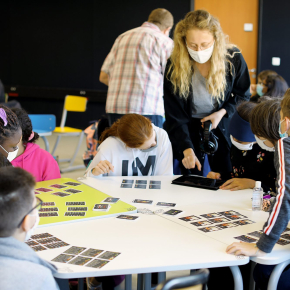
![Des élèves impliqués dans un projet long autour du jeu [Kosmopol:it]. © Christian Dury, CNRS, MSH LSE](/sites/default/files/inline-images/G25A7075.jpg)
When innovation rhymes with co-construction
In their own way, Alias and NumDiag both illustrate the shift in the humanities and social sciences as regards the social and environmental impact of innovation. Maria Teresa Pontois reflects on this shift in focus: "The humanities and social sciences work on scientific issues with high application and transfer potential – they're a true a source of ideas for solutions. That's why Rencontres Innov'SHS is a forum for interdisciplinary and interprofessional co-construction involving both scientists and socio-economic players".
The adventure of the [Kosmopol:it] board game testifies to the power of co-construction. This board game was the fruit of a collaboration between Lyon's Dynamique du Langage (DDL) laboratory
These are just some of the many projects that testify to the rapid growth of innovation in the humanities and social sciences in recent years (see key figures below). Marie Gaille, the director of CNRS Humanities and Social Sciences, explains that "a true community has developed over time whereas in the 2010s support had to be provided for colleagues who were sometimes unknowingly involved in innovation initiatives or because they didn't know much about how to go about it. As we're in the CNRS, our own innovation can be compared with various other forms in the other sciences which gives us a great opportunity to develop a fine-tuned approach to innovation in the humanities and social sciences and at the interfaces between them. Innov' SHS fully testifies to the involvement of the humanities and social sciences in innovation and provides time for thought, projection into the future and a celebration of original and inventive initiatives".