'VéloClimat' – science in the saddle
Corporate
A participatory science bicycle expedition in mid-July from Morbihan to Rotterdam aimed to measure the impact of global warming on cycling and anticipate the most effective changes for adapting to higher temperatures.
800 kms separate Rotterdam and Saint-Jean-la-Poterie in Britanny's Morbihan region. Erwan Bocher, Matthieu Gousseff and their colleagues
Although cycling is obviously beneficial for the climate and cyclists' health and posited as a solution for adapting to and mitigating global warming by the IPCC, the activity is particularly affected by weather conditions especially during summer heatwaves. However, the poorly adapted cycling infrastructure – for example asphalt tracks under direct sunlight – directly impacts cycling. "When weather conditions are bad, cyclists are likely to abandon their bikes for carbon-emitting modes of transport, mainly cars", sighs Matthieu Gousseff, a CNRS research engineer. His colleague Erwan Bocher, a CNRS research professor, explains that the VéloClimat project aims to anchor science in France's regions. "It's about adapting a carbon-free mode of transport to rapid climate change and anticipating the development of cycle paths straight away".
'Thermo parties' and a heat dome
On June 27th, the Lab-STICC staff members set out from Saint-Jean-la-Poterie where GEOMANUM, the CNRS-sponsored foundation in charge of the VéloClimat project, is based. Their tools for this expedition were 'bike climameters' designed to measure air and ground temperature, microparticle pollution and the closeness of vehicles on both sides of the bikes coupled with physiological sensors to measure their own body temperatures.
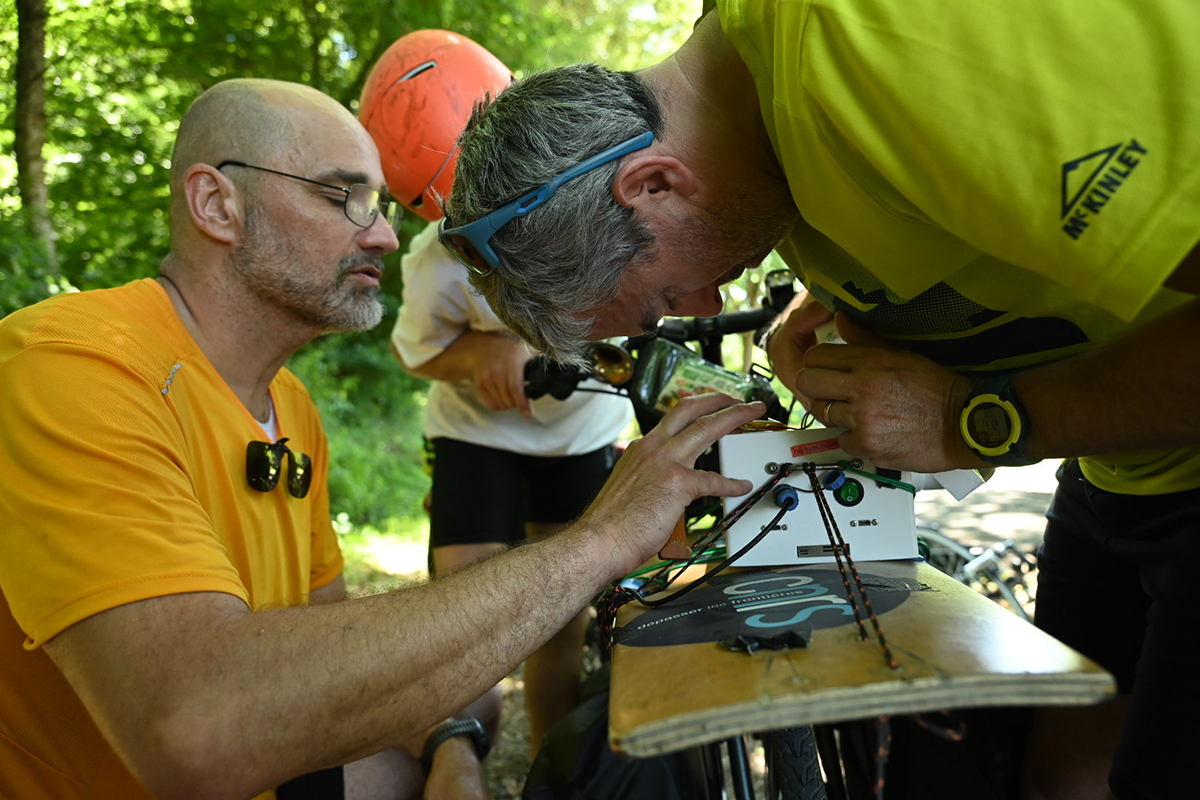
The team installs the 'bike climameters'© Perrin Remonté
"Unfortunately, we were unlucky enough to start out under a heat dome in early July", quips Erwan Bocher ruefully. In the Orne area, the group of cyclists was affected by the heatwave that hit western Europe for two weeks but conversely actually found this an opportunity for research. "Although Alençon's already quite green, we measured a difference at 11 p.m. of six degrees between the surrounding countryside and the city centre, bearing in mind that the urban heat island phenomenon peaks later in the night", explains the research professor. This general observation was backed up by local observations, neighbourhood by neighbourhood. "Depending on the morphology of the buildings and the neighbourhood's vegetation, the temperatures we measured varied a great deal", explains Erwan Bocher. "In some places, the ground temperature on a brand new cycle path went up to 70 degrees! The tarmac was melting and bubbles were bursting on the path..." The heat also had an impact on the researchers' own bodies. Matthieu Gousseff can testify to this as his own body temperature went up to 39.3°C which is considered a fever under normal circumstances.
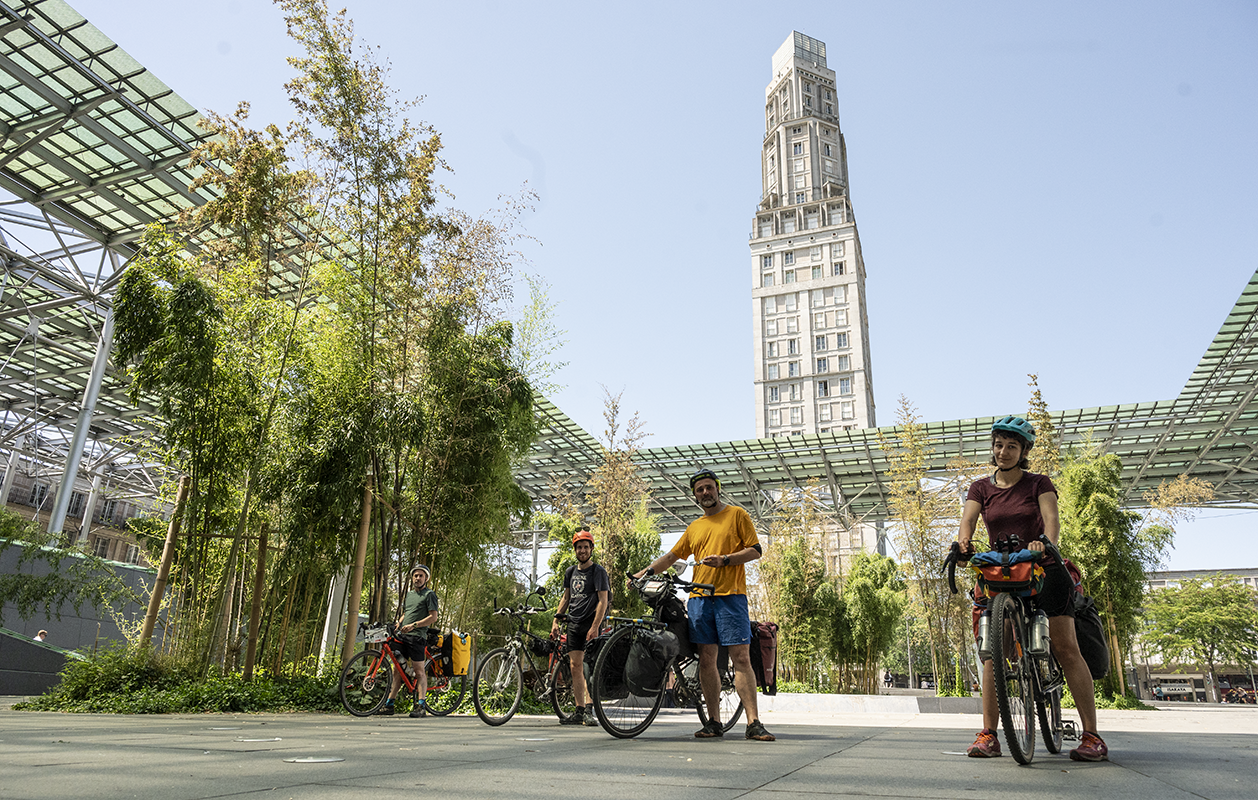
The team stops off in Amiens, at the foot of the Perret Tower.© Perrin Remonté
As well as their own measurements, during their journey the members of the VéloClimat project held 'thermo parties' in the French towns they passed through – Saint-Jean-la-Poterie the day before setting out, Redon in the Ille-et-Vilaine region, Alençon in the Orne region, Lille in the North and finally Ghent, Belgium. These participatory science experiments are in the same vein as the NoiseCapture app developed in 2017 by their laboratory and the Joint Research Unit in Environmental Acoustics (UMRAE)
Science is doing the hard yards
If these scientific data are transmitted to local authorities, they could feed into local public policy to help develop regional planning to promote cycling. As proof, the research engineer cites the pleasure of cycling safely and comfortably on Belgian and Dutch cycle paths which result from years of development. The coolness of the greenways and cycle paths shaded by trees in the Benelux countries reduced the heat stress on cyclists, making cycling easier even in hot weather.
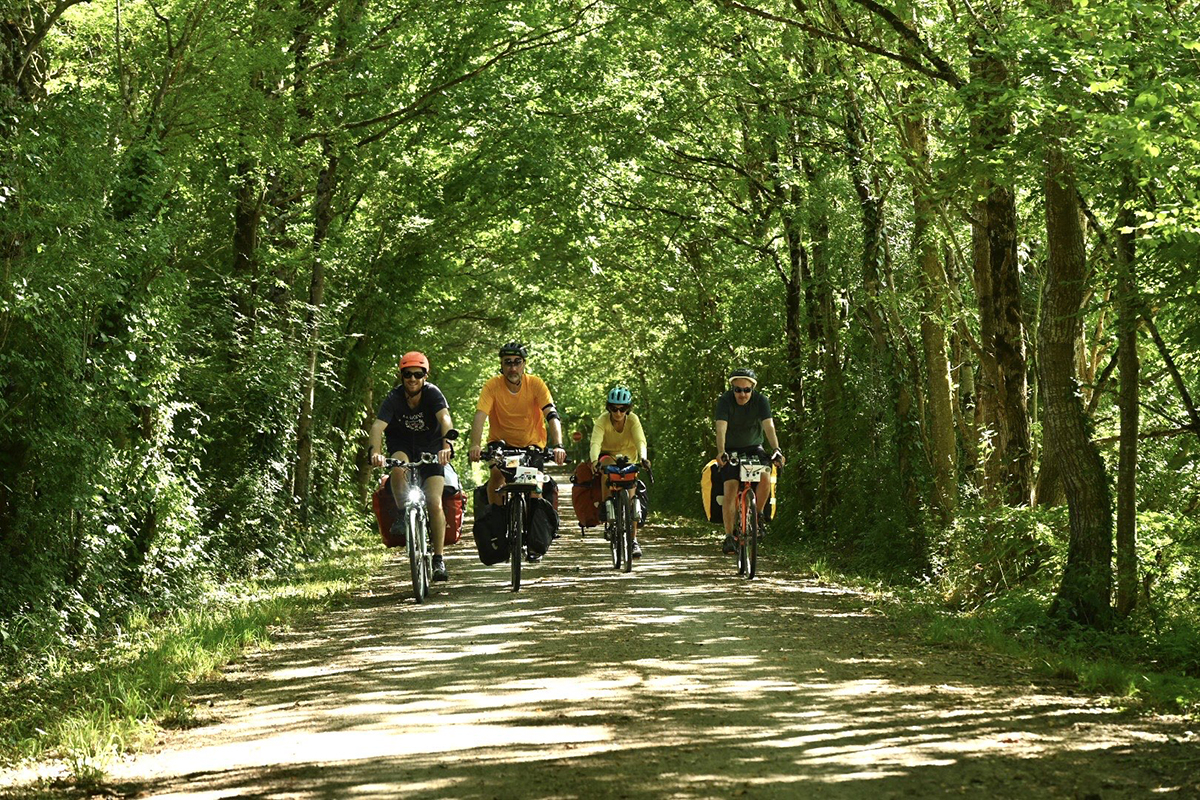
The team on the greenway between Mayenne and Alençon© Perrin Remonté
Now that the two scientists have returned to Brittany, it is time to take stock and ensure the VéloClimat project's long-term future. Erwan Bocher and his colleagues have already submitted a research project on the same subject to the French National Research Agency (ANR). As well possibly repeating these thermo parties in other places, the scientists now aim to turn this cycling trip to the ICUC conference into a regular event. Beyond its scientific importance, the project had a personal dimension for them that dovetails with scientific knowledge on global warming and the importance of promoting soft mobility. "There comes a time when you've got to go beyond awareness-raising and fundamental knowledge and do the hard yards", insists Matthieu Gousseff. "The margin for scientific progress shouldn't be used as an excuse for not taking action".
The CNRS promotes cycling
The CNRS has been actively promoting cycling and soft mobility since its first carbon assessment. In 2019 motorised vehicles accounted for 34% of the organisation's staff's home-to-work travel and 87% of carbon emissions in this category but now the use of such vehicles has dropped by 10% in three years. Active mobility (walking, scooters and cycling) has gained 20% in usage and such forms of mobility are the primary mode of daily transport (37%) for the CNRS's 33,000 staff members.
This rise in popularity was highlighted by the CNRS's first place in the national employer rankings during the 2024 'Mai à vélo' challenge
In the framework of the organisation's ‘Overall Sustainable Development and Social Responsibility Plan’ published in early 2025, the CNRS aims to equip all its sites with dedicated cycle parking spaces by 2027. This policy has been supported since 2023 by the national 'Employeur Pro-Vélo' (Pro-Cycling Employer)
The CNRS hopes cycling will become even more widespread, offering as it does a number of co-benefits for the CNRS and its employees. As well as reducing CO2 emissions and pollutants, cycling offers health benefits and means space can be reallocated for biodiversity and improving quality of life in the workplace. Researchers have estimated that every kilometre travelled by bicycle saves around 1 euro in healthcare costs in France

The DR13 team (Montpellier) during the ‘May On a Bike’ challenge in 2024© CNRS / A. Lieuvin