

Working towards sustainable research is also a scientific challenge
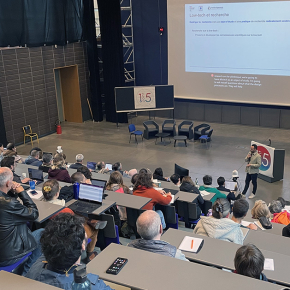
The Labos 1point5 research network recently organised its 3rd general conference on the Jussieu campus which provided the opportunity to take stock of work aimed at understanding, assessing and acting on the environmental impact of research.
Energy-consuming laboratories, travelling frequently to international conferences, intensive use of resource-hungry technologies... What if research could help identify and cut the environmental impact... of research itself? This is the objective of the Labos 1point5 research network (GDR
"It's important for thinking and work on the environmental transition to involve both management, which can provide the right administrative and regulatory framework, and staff members who have a vision of day-to-day life in laboratories", explains Stéphane Guillot, the CNRS's scientific officer for sustainable development and risks. "Combining these two approaches enables good ideas to emerge".
Three complementary work segments
"France is at the forefront in work on the ecological transition in research thanks to the unique community that the national and institutional structuring of Labos 1point5 helped create", confirms André Estevez-Torres
The GDR's work is organised into three main work segments which integrate a strong collaborative and multidisciplinary dimension supported by the 200+ people taking part. The 'footprint' segment gauges and characterises the carbon and environmental footprint of research activities while the 'transition' segment's members work on getting laboratories moving in the right direction and analyse the social, behavioural and organisational obstacles and levers to transition. Finally, the 'teaching' segment brings together and supports people involved in teaching ecological issues in higher education.
"One of the network's strong points has been the development of tools for both operational and scientific usage", explains the coordinator. These freely available tools are designed to be intuitive, user-friendly and "at the service of the community" (see box). They help laboratories assess their environmental impact so they can implement the right transition actions. However, they also provide the GDR's members with the data they require for their research.
The research network has notably built up a database of emission factors linked to scientific purchasing. This unprecedented tool
Decisive tools
The GDR's flagship tool
These calculations can be refined by working on the vocabulary of procurement codes. Currently, eco-responsible purchases come under the same purchasing code as similar more polluting purchases because the nomenclature was not originally designed for carbon accounting. One example is that vegetarian and meat-based meals come under the same 'meals' code. This all negatively affects the accuracy of estimates and the evaluation of replacement strategies. Such limitations can be overcome by analysing the life cycles of all the different purchases, particularly consumables and scientific instruments, although this represents a major challenge. Also, the researchers involved say that "the value of this systematic assessment also needs to be discussed because current measurements of the greenhouse gas footprints of several organisations are accurate enough to tell us that research's carbon footprint is already too high to comply with the targets set out in the Paris Agreement."
A scientific issue with a political dimension
More recent studies have found that major research infrastructures - particle accelerators like at the Cern, ground-based telescopes or satellites
André Estevez-Torres finds "this research network very interesting because its subject is both scientific and political, just like everything to do with the Anthropocene". The network provides conclusions that can help inform decisions on public policies and regulations on the basis of the data collected and analysed. For example, Tamara Ben-Ari
The Ministry of Higher Education and Research has also sought the GDR's scientific expertise. Labos 1point5 is taking part in a working group with stakeholders like France Universités, the CNRS and the French Agency for Ecological Transition (Ademe
Examining behavioural stumbling blocks
"The structuring of this GDR has enabled the creation of a research community but also a teaching community", adds the researcher. This means that all undergraduates should receive training including core knowledge on issues like climate change and biodiversity loss so the GDR is also producing content to be used in all universities which is an "innovative" approach. National conferences and events are also being organised so this new community can exchange ideas
Another GDR project is to involve more communities from the fields of health and the humanities and social sciences. These have an insufficient representation within the group but their input is essential for work on transition issues. One area of research is particularly intriguing - the issue of scientists who are aware of sustainable development issues but whose research has a significant environmental footprint. The CNRS provides specific support for scientists who want to change the direction of their research but it remains difficult to do so. The obstacles are administrative as much as psychological and sociological and now require specific study.
These two scientists are calling for the "broad debate" recommended by the CNRS Ethics Committee so scientific communities can examine the possibility of reducing certain forms of research and collectively identify the research topics to be prioritised or, conversely, limited." In this way, research can move towards becoming the model of environmental responsibility it can and should be.