How does the partially molten layer form above Mars’s core?
Space
|
A team from the CNRS, the National Museum of Natural History, and Sorbonne Université has demonstrated how a layer of partially molten rock forms approximately 1,550 km beneath Mars’s surface, and remains right above its core. At such depths, the rocks in the mantle begin to melt at temperatures approximately 100°C lower than previously thought, producing an iron-rich liquid that is denser than the surrounding mantle, and migrates down towards the depths. These experimental results provide a physical explanation for some of the seismic data gathered during the InSight mission (NASA-CNES). This research will be published in the journal Nature Geoscience on September 18th, 2026.
NASA’s InSight mission, launched in partnership with the CNES in 2018, sought to study the inner structure of Mars, thanks especially to analysis of the seismic waves spreading through its mantle. The data collected up through 2022 revealed, among other things, anomalies in wave propagation at the interface between the rocky mantle and its metallic core, suggesting the existence of a partially molten layer of rock. However, these observations did not explain how such a layer forms, or how it remains above the core.
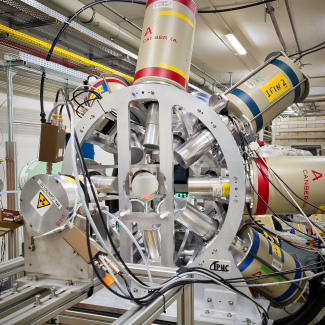
To understand the mechanism, the team reproduced, in the laboratory, the conditions governing the base of Mars’s mantle, namely by synthesizing a combination of rocks that are representative of the planet’s composition. They then subjected it to pressure reaching up to 18-19 GPa, approximately 180,000 times atmospheric pressure, at temperatures higher than those in fusion. Thanks to diffraction X-ray radiography techniques combined with ultrasound experiments, they observed the transformations produced when the rock begins to melt, and characterised the properties of the liquid being formed.
These experiments revealed that the first liquids appeared at a temperature approximately 100°C lower than previously thought by scientists. Unlike the hypothesis that posited the existence of an exceptionally iron-rich reservoir, the iron already present in the rocky mantle naturally concentrates in the liquid that forms at depths of 1,550 km or below. This iron-rich and highly mobile liquid becomes more dense than the solid rock surrounding it, allowing it to circulate throughout the rock, even in small quantities, and to then gradually sink towards Mars’s depths at a range of 1,550-1,750 km.
Once at the mantle’s base, the liquid accumulates above the core. As temperature increases with depth, fusion proceeds, continually driving this accumulation. As a result, rather than being dispersed in the mantle in the form of small pockets, the liquid ultimately forms a continuous and homogenous layer above the core. This is the first time, since the end of the InSight mission, that scientists have successfully dispelled some of the mystery surrounding the mechanism behind this molten layer’s presence beneath the surface of Mars.
Bibliography
Experimental constraints on a long-lived magma layer at the Martian core mantle boundary. Rémy Pierru, Steeve Gréaux, Serena Dominijanni, Lianjie Man, Yoshio Kono, Sho Kakizawa, Yuji Higo, James Badro, Daniel Frost et Daniele Antonangeli. Nature Geoscience, le 18 septembre 2026.