


Coastal urbanisation disrupts fish physiology
Environment
Life
Tourism, chemical pollution, noise and light pollution: urbanisation in coastal areas exposes fish to multiple stressors that affect their physiology. The effects are wide-ranging in juvenile fish and persist into adulthood, altering metabolism, the immune system and the hormonal mechanisms involved in environmental acclimation1, while also triggering inflammatory responses. These are the findings of CNRS scientists working at an international research laboratory based in Okinawa2. Paradoxically, these environments, enriched in organic matter, appear to act like ‘fast-food’ outlets, providing abundant and easily accessible food. This could make them particularly attractive to fish, despite the health costs. Adult fish living in urbanised areas show a high nutritional status while also displaying signs of chronic physiological stress. The study will be published on 9 October 2026 in Nature Communications.
- 1
The role of thyroid hormone signalling in environmental acclimation was also demonstrated by the same research team in a previous study”: Herrera, M., Miura, S., Chamot, Z., Reynaud, M., Gairin, E., Huerlimann, R., Ravasi, T., Besseau, L., Gibert, Y., Lecchini, D., & Laudet, V. Environmental tuning of thyroid hormone signaling drives developmental plasticity. Science Advances, 7 August 2026.
- 2
International Research Laboratory “Eco-Evo-Devo of Coral Reef Fish Life Cycle” (EARLY), CNRS/Okinawa Institute of Science and Technology.
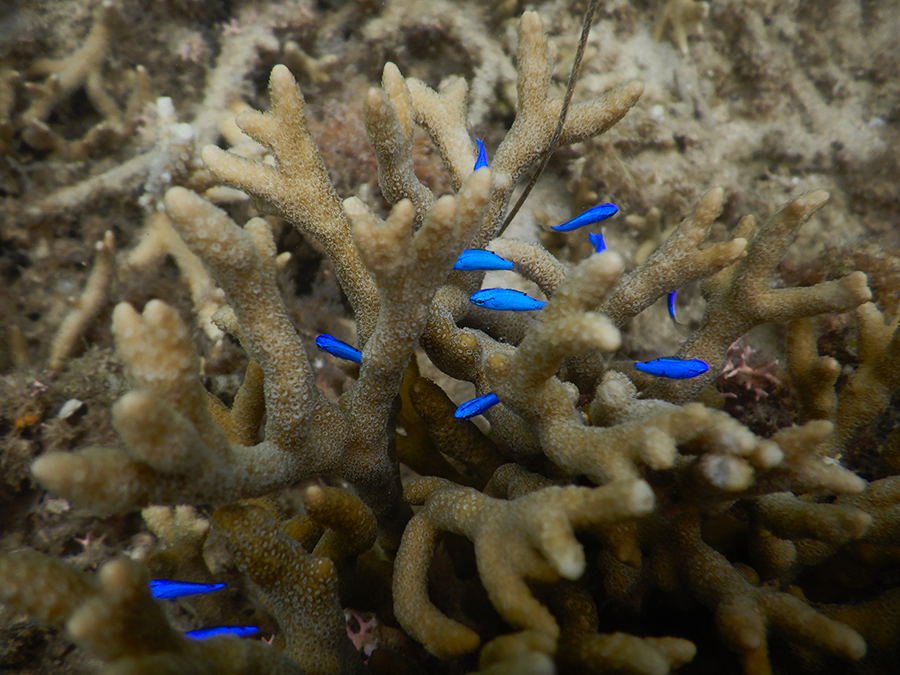
The findings were obtained using transcriptomic analyses3 which enabled the researchers to characterise gene expression in Chrysiptera cyanea, a common coral reef fish4. Natural populations were studied by sampling juvenile and adult fish at eighteen coastal sites in Okinawa with differing levels of urbanisation5. The scientists then analysed gene activity across the transcriptome to distinguish patterns associated with human activity from those linked to other factors, particularly temperature and nutritional status.
This work opens up a new way of monitoring the effects of environmental change. Rather than measuring environmental conditions alone, transcriptome analysis makes it possible to assess the physiological state of the organisms living there directly. In principle, this approach could be applied to many animal species and a wide range of ecosystems. The team now plans to investigate how these signatures change over time and in response to climate change, and to determine whether some of the environmental pressures identified in Okinawa’s coastal areas also affect the human populations living nearby.

- 3
Transcriptomics examines the full set of messenger RNAs produced by a tissue, organ, or whole organism. It can be used to identify which genes are expressed at a given time, and at what level.
- 4
Also known as the blue damselfish, the species is particularly abundant along the Okinawa coast.
- 5
Okinawa has several sharply contrasting environments: the north is relatively undisturbed by human activity, while urban areas are concentrated in the south, industrial areas in the east and tourist areas in the west.
Bibliography
Landscape transcriptomics reveals ecological constraints on fish under anthropogenic coastal change.
Emma Gairin, Saori Miura, Zoé Chamot, Camille A. Sautereau, Jann Zwahlen, Hiroki Takamiyagi, Yann Gibert, Marcela Herrera, Vincent Laudet. Nature Communications, 9 October 2026.

