The start of the environmental transformation of research professions
Corporate
The environmental transition has already begun in scientific practices and now research careers and professions are also starting the same transition.
"I was 43 which made me older than most of the colleagues who hosted me for my end-of-studies internship". Stéphanie Boniface still laughs recalling this. Beyond this anecdote, this former aeronautical engineer's reconversion to a profession that is compatible with her values and commitment to the environment is revelatory of a broader fundamental movement. Stéphanie Boniface is now the French higher education and research environmental footprint officer for the Institut Pierre-Simon Laplace (IPSL) which coordinates climate science research in the Paris region. The environmental transition affecting all research professions remains marginal and is still far from representing a "Big Bang in research". However its effects can be seen in "readjustments within disciplines and shifts towards subjects that are both common and new to all involved" explains Olivier Leclerc, a CNRS research professor at the Centre for Legal Theory And Analysis (CTAD) and rapporteur for the CNRS Ethics Committee's (Comets) opinion 'Intégrer les enjeux environnementaux à la conduite de la recherche – Une responsabilité éthique' (Integrating environmental issues into the conduct of research - An ethical responsibility).
Both administrative and scientific profiles are involved in career changes of this sort but all derive from the same logic in which something clicked into place. Stéphanie Boniface's realisation dates back to September 2014 and her first climate march

The emergence and resurgence of professions
New professions are also emerging alongside such examples of retraining and this is the case for Stéphanie Boniface who admits that her post at the IPSL "develops as we go along" and also for Carole Mainguy, the first transition officer at the CNRS's West Occitania regional office (one of the organisation's eighteen regional offices). This former communications officer already devoted 20% of her time to environmental issues but now has been given a full-time post doing so. Rather like Stéphanie Boniface, she admits that there are "legitimacy issues with such a very wide-ranging profession" covering everything from raising staff awareness to managing regional projects. Such initiatives include a new set of specifications for maintaining green spaces that follow the IPBES recommendations and also providing local support for environmental transition training for public sector staff. These aspects all need to be reconciled so West Occitania's transition officer's position is to "facilitate diplomacy" so as to "work on making subjects more acceptable that were often divisive and sometimes seen as just making people feel guilty."
Alongside these developments, other professions that were previously seen as in decline are now coming back into favour. At a time when laboratories are increasingly thinking about using glass instead of plastic, glassblowers could have a role to play in research's environmental transition. Cécile Valter, a glassblower with a twenty-year career at the CNRS's Rennes Institute of Chemical Sciences, notes that her "profession has completely taken off. We work more and more for several laboratories and get more and more work linked to the institute's growth because scientists appreciate our prices being 5 to 10 times less than those of the private sector and also the speed we work at". Her colleague Thierry Pain was awarded the CNRS Crystal Medal in 2020 and thinks similarly. "It's a profession that's going to last. So many young people are still signing up at the Lycée Technique Dorian - the only school that gives training in scientific glassblowing - and also there'll always be a demand." Another example came in 2022 when the European Centre for Research and Training in Glass Arts (CERFAV) in the East of France launched a CAP
Finally, other staff members have already integrated the environmental transition into their skill sets. Aurore Debono is a public procurement and purchasing techniques officer with the CNRS's Purchasing and Innovation Office (DDAI). She describes the context of her former job in purchasing. "Sustainable development in public procurement is not a new thing - as early as the 1990s, optional social and environmental criteria were included in French public procurement contracts. The result is that, thirty years on, the sixty or so buyers in our regional offices today do know about regulations like the (French) Climate and Resilience Law

Towards an institutional framework for individual transitions?
However, some professions and areas of research could undergo radical change alongside those that are emerging. Olivier Leclerc assumes that "certain research could be restricted or even banned because of its negative impact on the environment. An approach like this to environmental ethics would be similar to the approach used for bioethics". The Comets rapporteur cites the examples of research into geo-engineering or hydraulic fracturing techniques for oil production aimed at leaving fossil resources underground as the IPCC recommends. This brings up the question of how the environmental transition should be managed for research professions by scientific institutions. Until now, changes have been made at an individual level but "this policy of individuals volunteering necessarily slows down people's careers", regrets Camille Scalliet, a young CNRS researcher with the Physics Laboratory of the ENS
Because individual transition can come at a cost some cannot afford. All the people interviewed for this article were lucky enough to have a stable family and professional situation when their jobs changed. Carole Mainguy's experience as communications officer in the same regional office meant she "felt at ease changing jobs without plunging into the unknown as I benefited from experience in the field and was familiar with the structures of the organisation and its partners". For her part, Camille Scalliet recognises that "tenure at the CNRS has given me flexibility and enabled me to question research practices which a post-doctorate post does not offer". André Estevez-Torres openly admits he was "lucky enough to be paid to produce knowledge" and "started from a particularly privileged position - with an ERC Consolidator Grant
In the same way as the Labos 1point5 research network, a number of CNRS units are setting up gateways to support the transition or, at least, are integrating environmental issues into research professions. This is the case at CNRS Engineering, one of the organisation's ten Institutes, which set up a support and research unit (UAR) dedicated to life cycle assessment (LCA)
The CNRS is gradually taking over the management of the institutional framework for the environmental transition of scientific careers without forcing its staff members to choose one profession rather than another. In this context, the CNRS is already anticipating the issue of the skills required for the environmental transition which it has integrated into discussions on its upcoming Objectives, Resources and Performance Contract. The stakes are considerable. As Olivier Leclerc reminds us, "we need to make sure the CNRS's low-carbon policy corresponds to the professional realities of research professions".
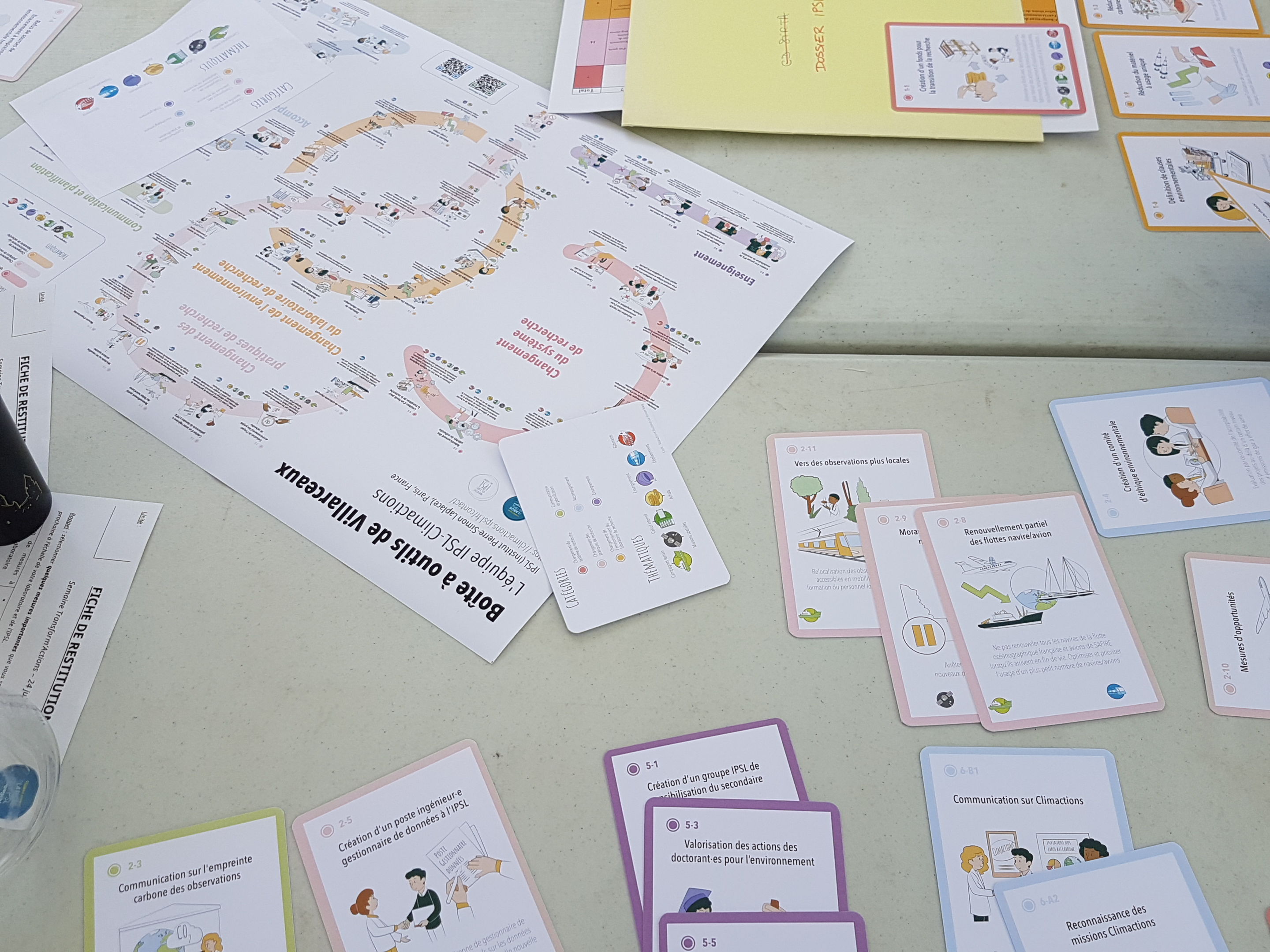
Group animation at IPSL@ Marie Pinhas / IPSL