Foetal loss in wild mandrills, an adjustement of maternal investment
Paris,
Life
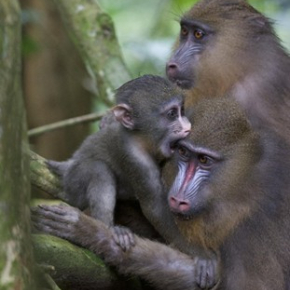
In wild mandrills, a primate from Central Africa studied in Gabon, females who become pregnant while still caring for a dependent infant face a higher risk of foetal loss. This risk increases further when the infant displays higher levels of tantrum behaviour1, suggesting mother-infant conflict over maternal investment.
These findings come from a CNRS research team2 that monitored 117 females and 356 pregnancies over 11 years.
However, foetal losses do not appear to solely represent reproductive failure, but may also help reduce the costs of closely spaced reproductive events. Indeed, the researchers also found that, over the medium term, females who lose a foetus have better reproductive outcomes than those who give birth but subsequently lose their infant: they produce more surviving offspring and experience shorter intervals between births. These findings are due to be published in PLOS Biology on 3 November 2026.
These findings, from the long-term Mandrillus3 project, highlight the importance of long-term studies for understanding how behaviour and reproductive events are linked across generations.
Notes:
- Types of behaviour similar to the tantrums observed in young human children.
- Based at the Institut des sciences de l'évolution de Montpellier (Montpellier Institute of Evolutionary Sciences) (CNRS/IRD/Université de Montpellier).
- The Mandrillus project, launched in 2012 in Gabon, conducts long-term research into the socio-ecology of wild mandrills through daily monitoring of their behaviour, demographics, health and environment.
Bibliography
Infant presence and mother-infant conflict predict fetal loss in wild mandrills. Nikolaos Smit, Berta Roura-Torres, Axelle Delaunay, Alice Baniel, Elise Huchard, Marie J. E. Charpentier, PLOS Biology, 3 November 2026.