Spotlight
Find out about the latest CNRS research working towards a sustainable ocean.
https://lejournal.cnrs.fr/dossiers/locean-un-monde-a-decouvrir
The CNRS's researchers come from all disciplines which means it is in a unique position to coordinate and facilitate all dimensions of ocean research. It also provides decision-makers with the right scientific knowledge they need for important policy choices. The single objective of this work is to better understand the world's oceans and preserve them in a sustainable way.
The world’s oceans cover three quarters of the Earth's surface and contain 97% of our planet's water. Over three billion people are dependent on marine and coastal biodiversity in today’s world but the human footprint on the oceans is becoming an increasing menace for the marine environment and the ecosystem services it provides like fishing resources. This menace derives from multiple forms of man-made pollution such as plastics, wastewater, pesticides and hydrocarbons combined with the negative effects of overfishing, ever-increasing maritime traffic, the development of the blue economy, the impacts of climate change with melting ice and increasingly regular extreme climate events. Preserving the oceans is therefore an issue of major importance including for France, of course. France is the second largest country in the world just behind the United States in terms of maritime territory with nearly 11 million km2 - four times the size of the Mediterranean Sea - spread over all the oceans.
However the ocean is a complex environment. The whole subject requires coordination that goes far beyond marine science alone to ensure and enhance the oceans' chances of preservation. This involves coordinating research and other activities in areas ranging from the continents to the deep sea, from the molecule right up to the global system, from ecosystems to human societies and their many uses of the ocean to sharing knowledge with decision-makers, professionals and the general public.
The CNRS is one of the world's leading research organisations and has over 1000 scientists studying the ocean in all its dimensions in around fifty laboratories. These research forces mean the organisation is capable of forging alliances to work on the subject between a wide range of disciplines including oceanography, physics, sociology, biology, ecology, geology, mathematics, chemistry, economics and even philosophy.
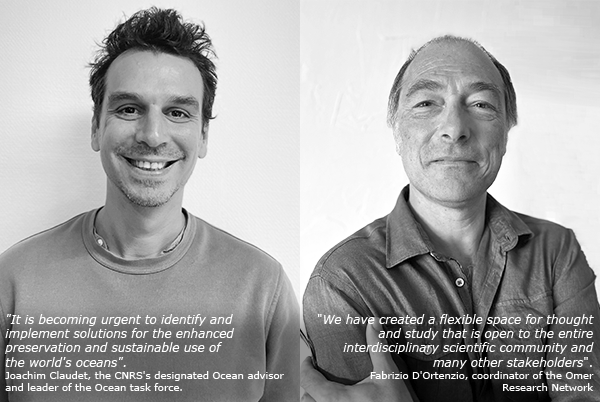
The CNRS's designated Ocean advisor, Joachim Claudet, has developed a scientific strategy in collaboration with the CNRS Institutes to support the research organisation and cooperation on this subject. This strategy's aim is to carry out interdisciplinary research and provide effective responses to the questions asked about the oceans by society and decision-makers. More specifically it is based in particular on an Ocean task force that brings together the 10 CNRS Institutes and also on the Omer Research Network coordinated by Fabrizio D'Ortenzio that features a wide range of interdisciplinary and multi-organisation scientific expertise.

The CNRS is steering or co-steering 37 national programmes (PPRs and PEPRs ) with several devoted to the oceans. These involve targeted thematic and geographical research that aims to provide society with tangible responses. The CNRS also works with national, European and international decision-making bodies to provide them with the right scientific knowledge and help inform political choices involving the sustainability of the ocean.
The 'Océan Climat' Priority Research Programme (PPR) co-steered by the CNRS and the French Research Institute for Exploitation of the Sea (Ifremer).
Six Priority Research Programmes and Equipments (PEPRs):
In France:
In Europe:
Internationally:
The work of all the sciences present at the CNRS on the ocean reveal an infinite number of stories about our planet and the living beings that live there. CNRS scientists also explain how human societies preserve close links with and even depend on the world's oceans but also conversely how they threaten them.
Let's take a look at some of the discoveries made in the Earth's 72.8% of salt water:
Every dive into this mysterious universe brings up a new unique story to tell. The countless riches brought back from underwater expeditions open up new pages of knowledge about the deep oceans - unknown species, harmful traces of human activity and so on. Researchers then work fast to analyse this information to find out more about the mechanics of the oceans and how to preserve them more effectively.
Life was born in the ocean with the appearance of the first photosynthetic organisms and animals appeared. Researchers' work teaches us about the mechanisms that link these species together by quantifying their diversity and warning about changes caused by external attacks.
The Earth's habitability is determined by the health of its oceans which produce half the planet's oxygen while feeding us and helping treat our ills. Things can only improve if we balance the conservation of marine ecosystems with the sustainable exploitation of ocean resources. Geographers, legal specialists, political scientists and archaeologists can guide us regarding how forms of governance need to be adapted, the best ways to regulate equitable access to resources and the adaptation of coastal and island populations.
Living in harmony with the ocean depends on our ability to preserve and restore it. To keep it safe from the global upheavals we are undergoing, scientists are working to identify the threats, gauge their impact and put forward solutions.
The ocean is an infinite source of innovation - from pharmaceutical research to cosmetics, marine renewable energies, biomimicry and biofuels. The ocean's depths provide us with precious resources and also promising solutions.