


Offshore wind farms and biodiversity: findings from the Ifremer-CNRS scientific assessment
Corporate
Environment
To inform public decision-making on the deployment of offshore wind energy: • ESCo, a collective scientific assessment of offshore wind farm and biodiversity commissioned by the French government, provides an overview of the international scientific evidence on the effects of offshore wind farms and their grid connections on marine biodiversity and marine and coastal socio-ecosystems. • Based on a systematic review of the international scientific literature, it examines the effects of ten different sources of pressure exerted by these infrastructures. While some are relatively well documented, others – particularly long-term and large-scale effects – remain poorly understood. • The assessment also identifies a range of mitigation measures studied in the scientific literature. |
As offshore wind becomes increasingly central to decarbonisation and energy sovereignty strategies, it is playing a growing role in French and European public policy. However, its development may affect coastal ecosystems that are already facing multiple pressures and ongoing biodiversity loss.
Against this backdrop, policymakers need access to robust scientific evidence. Commissioned by the French energy, ecology and maritime ministries, Ifremer and CNRS carried out a collective scientific assessment to establish the current state of knowledge on the effects of offshore wind farms on marine biodiversity and marine and coastal socio-ecosystems, in addition to research by the Observatoire national de l’éolien en mer (ONEM).
Drawing on a systematic review of the international scientific literature, the assessment identifies the impacts that have been documented to date, highlights fundamental uncertainties, and reviews the mitigation measures examined in published research. It therefore provides an independent body of knowledge to inform public decision-making and debate on the deployment of offshore wind energy.
Offshore wind farms are becoming an increasingly vital component of energy transition strategies in France and across Europe, helping to reduce reliance on fossil fuels, cut greenhouse gas emissions and strengthen national energy sovereignty. In this context, it is essential that decision-makers have access to the best available peer-reviewed scientific evidence to anticipate the effects of offshore wind development on marine biodiversity and to implement the most appropriate measures to mitigate them.
With this objective in mind, Ifremer and CNRS conducted a collective scientific assessment between January 2024 and June 2026 with a multidisciplinary team of researchers from 13 French and Belgian public research institutions.
The experts identified more than 4,500 scientific publications and selected 411 articles for an in-depth analysis of the effects of offshore wind energy on marine biodiversity. The resulting ESCo assessment is currently the most comprehensive state-of-the-art review available on the subject, addressing the need to bring together, synthesise and share the scientific knowledge available on offshore wind and its environmental impacts.
TEN SOURCES OF PRESSURE AFFECTING MARINE ECOSYSTEMS
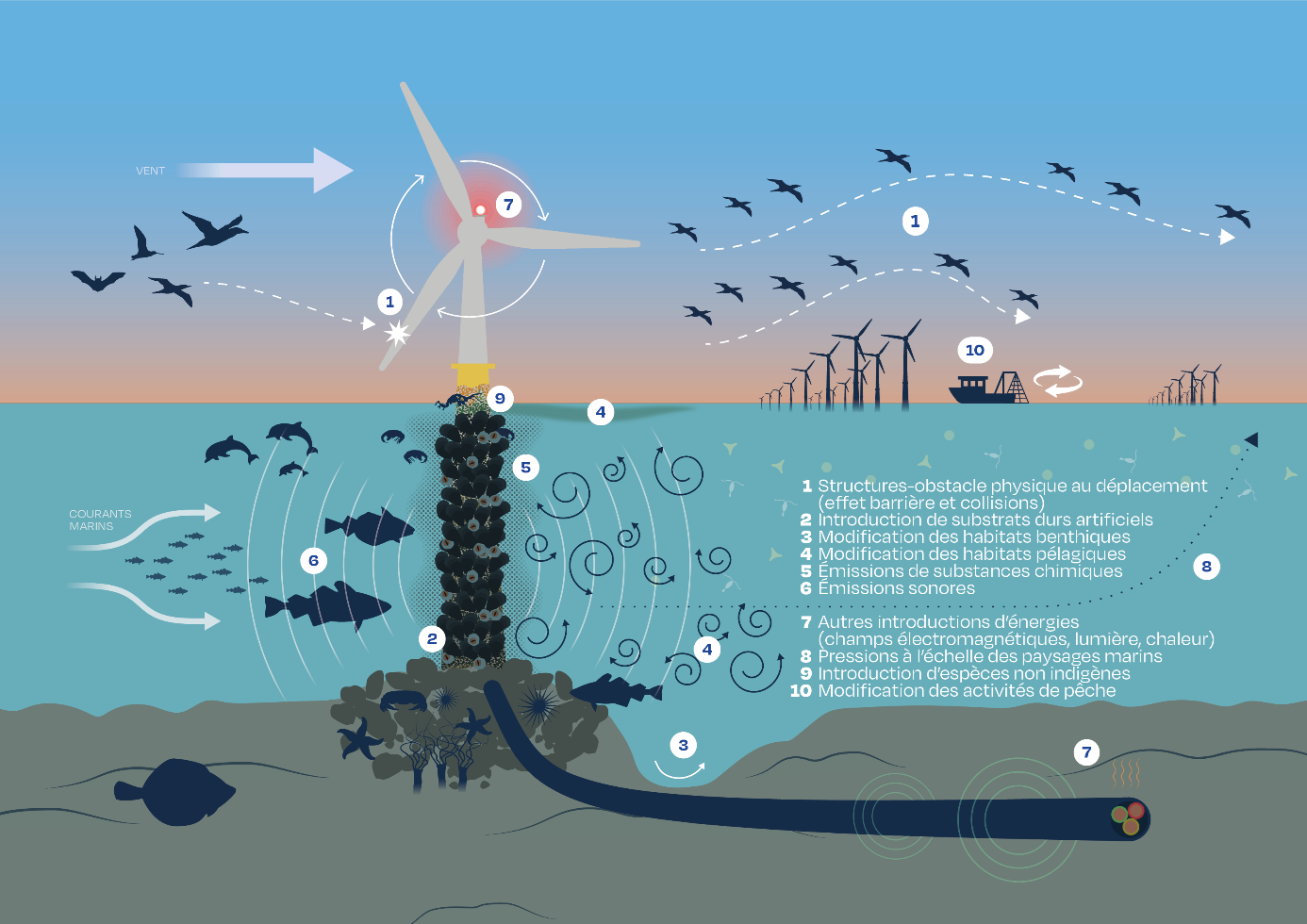
The ESCo assessment examined ten ways in which offshore wind farms could affect biodiversity during the different stages of a project’s life cycle, from construction through to decommissioning:
Physical structures acting as barriers to movement (barrier effects and collisions)
The introduction of artificial hard substrates (reef effect)
The alteration of benthic habitats
The alteration of pelagic habitats
Chemical emissions
Underwater noise
Other forms of energy added to the environment, including electromagnetic fields, artificial light and heat
Pressure at the seascape scale
The introduction of non-native species
Changes in fishing activities (reserve effect)
The assessment also identifies a range of mitigation measures studied in the scientific literature. However, it points to significant knowledge gaps regarding certain pressures and their long-term and large-scale effects, underlining the need for further research and a stronger base of scientific evidence.
Taken together, these findings are intended to inform public decision-making and debate on the deployment of offshore wind energy, at a time when France and Europe are seeking to reconcile the goals of energy decarbonisation and the protection of marine biodiversity.
FOCUS: THREE WELL-DOCUMENTED PRESSURES
Offshore wind turbines act as barriers to movement
Offshore wind turbines can constitute physical obstacles to the movement of certain mobile species, such as seabirds, migratory land birds and some migratory bat species. Two main types of effects have been documented.
The first is a barrier effect: certain flying species alter their flight paths to avoid wind farms, potentially extending distances travelled or reducing access to feeding and resting areas.
The second concerns the risk of collisions with turbine blades, which can result in bird and bat mortality. Species most at risk are those that regularly fly at rotor height, particularly during nocturnal migration or when they frequently enter wind farms to forage.
However, the effects observed vary considerably depending on the species involved, weather conditions, distance from the coast and the configuration of the wind farm.
While these effects are now well documented for birds, evidence remains more limited for bats and for the potential underwater barrier effects on marine mammals, turtles and fish.
Offshore wind turbines introduce new artificial hard substrates
The installation of turbine foundations and rock armour creates new underwater habitats that may promote the establishment of certain species.This phenomenon is known as the reef effect.The submerged structures are rapidly colonised by dense populations of mussels, barnacles and small crustaceans, which progressively establish themselves on these hard surfaces. In certain North Sea wind farms, a single turbine foundation can support up to two tonnes of mussels. This colonisation is accompanied by a substantial local increase in biomass—the total amount of living matter present—as well as changes in the composition of the species communities surrounding the structures.
In the case of certain fish species, including Atlantic cod and European plaice, several studies have reported local increases in abundance and, in other cases, average body size in the vicinity of offshore wind turbines. Species can also alter their diet, feeding more heavily on organisms associated with these artificial structures, potentially leading to changes in local food webs.
Offshore wind turbines generate underwater noise
During the construction phase, pile driving operations used to install certain types of foundations generate high-intensity underwater noise that can carry over dozens of kilometres.
Documented effects include behavioural changes, avoidance responses, altered movement patterns and disruption of biological functions that rely on sound, particularly in marine mammals.
However, available evidence is based largely on studies of the harbour porpoise, a species that has been extensively researched in the north-east Atlantic. Avoidance behaviour in harbour porpoises has been observed at considerable distances from offshore wind farm construction sites. Human-generated sounds have been found to mask biologically important sounds used by animals and cause temporary hearing loss (permanent hearing damage appears to be less common).
In fish, studies primarily describe stress responses and temporary behavioural changes. By contrast, the effects of lower intensity but more persistent underwater noise generated during the operational phase of offshore wind farms remain insufficiently documented.
EXISTING MITIGATION MEASURES
The ESCo assessment also provides an overview of the measures investigated to reduce the impacts of offshore wind farms on biodiversity. These measures follow an ‘avoid, mitigate and compensate’ framework (ERC) applied during the planning, construction and operational phases of offshore wind projects.
Avoidance measures are designed to eliminate potential impacts from the earliest stages of project planning, particularly through site selection. For example, they include avoiding major migration routes and breeding areas used by certain bird and marine mammal species, as well as the most sensitive habitats.
Mitigation measures—which account for 85% of the studies analysed—mainly address noise pollution and collision risk. Several techniques have been tested during construction to reduce acoustic interference during pile driving, including bubble curtains, which attenuate the propagation of underwater sound, and soft-start procedures, whereby sound levels are gradually increased to encourage marine mammals to move away before full-intensity operations begin.
For birds and bats, measures aim to reduce collision risk, for example, by temporarily shutting down turbines during certain migration periods or under specific weather conditions. Other studies have explored design modifications, particularly to improve the visibility of turbine blades.
Compensation measures seek to restore or recreate habitats or ecological functions where impacts cannot be avoided or sufficiently reduced. However, evidence on the effectiveness of these approaches remains limited.
More broadly, the assessment identifies several limitations. Research on mitigation measures is concentrated on just a few taxonomic groups—primarily marine mammals and birds—and on a limited number of pressures, such as underwater noise and collision risk. Moreover, many identified measures have yet to be evaluated under real operating conditions, meaning that evidence of their effectiveness remains limited.
KNOWLEDGE GAPS STILL TO BE ADDRESSED
Despite the rapid growth in scientific research on offshore wind energy, important knowledge gaps remain. Certain pressures have received relatively little attention, including chemical emissions, artificial light, the consequences of introducing non-native species, and certain impacts occurring at broader spatial scales beyond the wind farm itself.
Likewise, little is known about long-term effects. Most studies continue to focus on responses observed at local or individual scales, while the consequences for food webs, ecological connectivity—the movement of species and the circulation of organisms between habitats—population dynamics and the overall functioning of ecosystems remain insufficiently understood.
Scientists also highlight the lack of research into the cumulative effects of the different pressures generated by offshore wind farms, as well as interactions with other human activities already taking place at sea, such as fishing, shipping and climate change.
Long-term monitoring programmes are also needed to distinguish the effects of offshore wind farms from the natural variability of marine ecosystems. In addition, scientific knowledge remains limited for floating offshore wind farms, Mediterranean environments and the decommissioning phase of offshore wind installations. Most available evidence comes from bottom-fixed wind farms in the North Sea, predominantly located on soft (sand or mud) seabeds. Consequently, these findings should be applied with caution to other ecological, technological and management contexts, particularly those found in mainland France.
In light of these challenges, the assessment emphasises the need for more integrated approaches, enhanced evaluation of mitigation measures, and greater harmonisation of monitoring protocols and methodologies to facilitate comparisons between sites. It also highlights the importance of improving the scientific community’s access to environmental monitoring data collected by offshore wind operators.
The ESCo assessment was conducted by a multidisciplinary team of 25 researchers, led by Cédric Bacher (Ifremer) and Nathalie Niquil (CNRS). The team brings together specialists from 13 public research institutions, drawing on complementary expertise in marine ecology, oceanography, acoustics, geology, chemistry, modelling, economics and geography to address the full scientific scope of the assessment. This broad disciplinary expertise ensures both scientific rigour and a diversity of scientific perspectives. The assessment has been identified as a key contribution to the work of the Observatoire national de l’éolien en mer (ONEM) and is supported in this capacity by the French Ministry for the economy, finance and industrial, energy and digital sovereignty. Established in 2022 by the three ministries that commissioned the assessment, the ONEM aims to inform public debate on the environmental impacts of offshore wind farms by promoting existing knowledge and supporting new research programmes. In line with the scientific assessment charters of CNRS and Ifremer, the assessment was conducted independently of the Observatory.
Resources
Read the Executive Summary and the Summary Report on the Ifremer and CNRS websites.
Visit the ESCo website: https://esco-eoliennesenmer.fr/
Read the CNRS article : "Éoliennes en mer et biodiversité : la science prend le large"

