
“Proust’s madeleine” finally explained by neuroscience
Life
A team of CNRS scientists1 has just pinpointed the brain mechanisms and scientific explanation behind the famous ‘Proust’s madeleine’ phenomenon, in which smells bring back vivid and emotive memories2. This work, published in PLOS Biology on 14 July 2026, shows that early-life olfactory experiences leave a lasting impression on the brain capable of reactivating the context and emotions associated with that memory throughout our lives.
The neuroscientists revealed the central role played by the neurones of the olfactory bulb3, an area of the brain that continues to develop during childhood. When these neurones are reactivated in adulthood by odours we experienced in childhood, they call on cerebral circuits involved in both the memory and the reward. As we grow and age, the brain’s networks become reorganised, and the memory becomes progressively more anchored to the emotional circuits.
The researchers made this discovery by first collecting data through a survey conducted with volunteers. They then used this data to design an experiment using mice4.
The study also shows that the ‘Proust’s madeleine’ effect is created by repeated association of a particular smell with positive experiences during childhood and throughout life. Over time the memory becomes imprinted in the brain’s circuits, explaining its remarkable persistence and strong emotional impact.
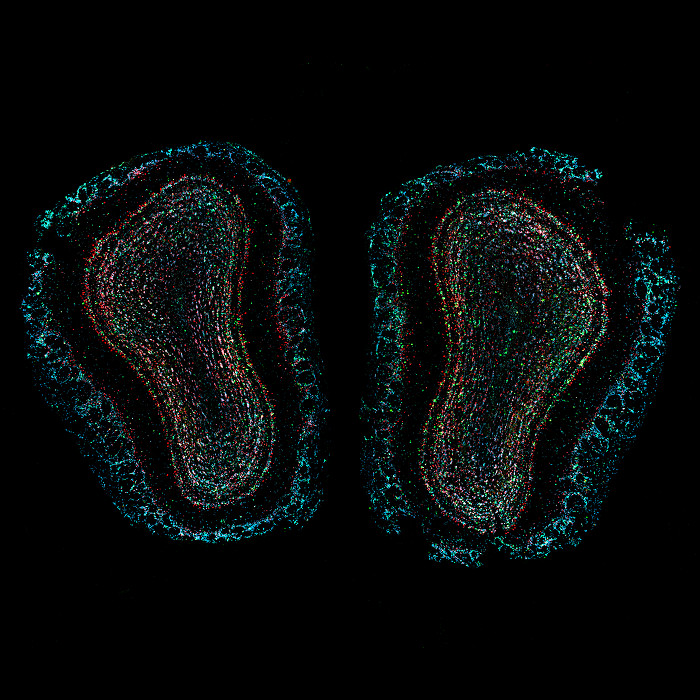
© Jules Dejou, Université Claude Bernard Lyon 1, 2026.
Notes
- Working at the Centre de recherche en neurosciences de Lyon (CNRS/Inserm/Lyon 1 Université).
- Named in honour of Marcel Proust, author of the French novel A la recherche de temps perdu (1913) in which the narrator describes the impression of memories evoked by the taste of a madeleine dunked in tea. The “Proust’s madeleine” phenomenon can also occur in response to stimuli involving all the senses.
- Located in the anterior cranial fossa, under the frontal lobe.
- During their early life, the mice were exposed to an attractive odorant, associated with an enriched, playful and positive environment. In adulthood, they were re-exposed to this same odorant in a neutral environment so as to evaluate the persistence of the olfactory memory.
Bibliography
Positive early-life olfactory memory is rooted in the olfactory bulb and triggers large-scale changes beyond the olfactory system
Jules Dejou, Anna Athanassi, Théo Brunel, Marc Thevenet, Anne Didier, Nathalie Mandairon, PLOS Biology, 14 July 2026
DOI : https://doi.org/10.1371/journal.pbio.3003845