
Island biodiversity disproportionately exposed to global change
Environment
Life
|
Island ecosystems face an alarming level of exposure to global change. By 2050, climate change will be the dominant threat for 65% of them; 22% will be affected primarily by land-use change; and 13% will face greater threats from biological invasions. France is among the 31 countries with a disproportionately high number of islands exposed to all three threats. These are the findings of an international research team led by scientists from CNRS, the French Foundation for Biodiversity Research (FRB) and the Université de Pau et Pays de l’Adour, with funding from the FRB1. The findings will be published in PNAS on 27th July.
- 1
These findings are from the FRB-Cesab Rivage project: https://www.fondationbiodiversite.fr/la-frb-en-action/programmes-et-projets/le-cesab/rivage/
Although they account for just 7% of the Earth’s land surface, island ecosystems harbour almost 20% of the world’s biodiversity. From sea-level rise to biological invasions, islands are facing multiple pressures associated with ongoing global change, and yet they are still overlooked in global biodiversity conservation strategies1.
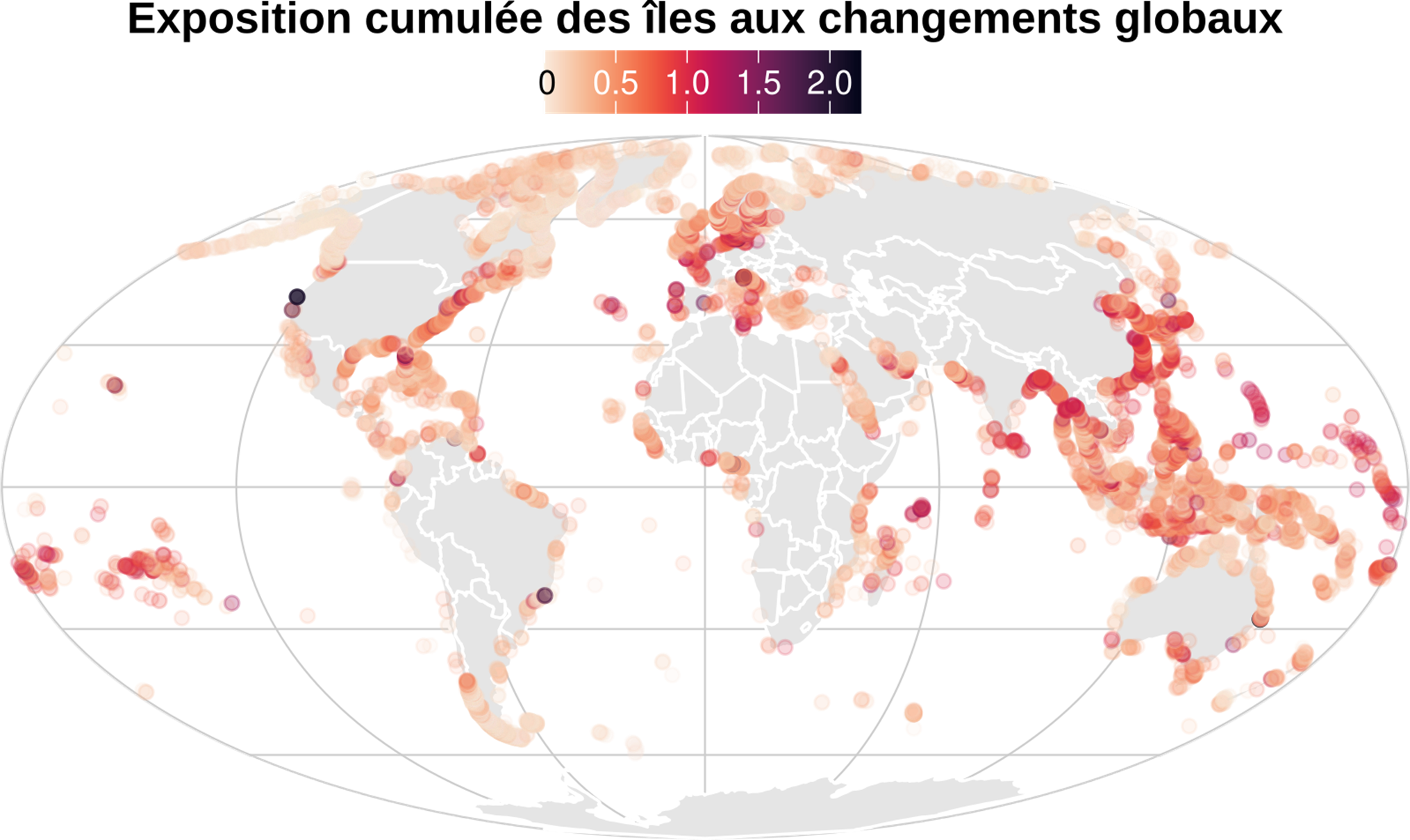
Scientists from the Écologie, Société et Évolution (ESE) laboratory (AgroParisTech-Paris/CNRS/Université Paris Saclay) and the Centre for the Synthesis and Analysis of Biodiversity (CESAB)2 have completed the first global assessment of the exposure of islands larger than one square kilometre to global change. Their findings are alarming: by 2050, climate change will be the dominant threat for 65% of island ecosystems; land-use change will be the primary threat for 22%, particularly in the Pacific (Micronesia and Fiji), the Baltic Sea, the Bay of Bengal and Southeast Asia; while biological invasions will be the main threat for 13%, posing a heightened risk to temperate islands such as those in Northern Europe.
The team also identified the countries and regions most disproportionately exposed to these risks, based on the number of islands located there. France has an unusually high number of “exposure hotspots” — islands highly exposed to all three threats — including in French Polynesia and certain islands in mainland France. This places it among the 25% of countries most exposed. The Seychelles, Bangladesh, China, Fiji, Micronesia, Denmark, Sweden, India and Japan are also affected.
In response to these findings, the authors call for stronger protection of islands in the 31 countries identified as having a disproportionately high number of exposure hotspots, through locally tailored strategies. Ecosystem restoration and the development of protected areas are among the solutions that can both limit the impacts of climate change and reduce opportunities for the establishment of invasive alien species. The exposure maps produced by this research are valuable tools for prioritising action.
The research team also stresses the importance of developing complementary datasets to the ones used in this study, so that other currently underrepresented threats can be included, such as plastic, pesticide and light pollution, as well as the overexploitation of resources.
The findings were obtained by combining several existing datasets with original modelling at the scale of the world’s islands. Additional models were developed to produce projections for 2050. Maps showing the exposure levels of the 16,578 islands analysed make it easy to identify the island territories facing the greatest threats.
- 1
For example, the Kunming-Montreal Global Biodiversity Framework (2022)
- 2
Scientists from the EDYSAN (Ecologie et dynamique des systèmes anthropisés) laboratory (Université Picardie Jules Verne) and the Institute of Analytical Sciences and Physico-Chemistry for Environment and Materials (IPREM) (CNRS/Université Pau et Pays de l’Adour)
Bibliography
Global threat exposure of islands in a changing world. Marino, C., Philippe-Lesaffre, M., Coutinho Soares, F., Caetano, G., Etard, A., Butt, N., Capdevila, P., Irl, S. D. H., Leclerc, C., Lenoir, J., Patiño, J., Rigal, F., Benítez-López, A., & Bellard, C. PNAS, 27th July 2026.

