"The CNRS seeks scientific excellence throughout Canada"
A year after the CNRS's first international research centre was inaugurated in Canada, the new director of the CNRS office in Ottawa, Andréa Dessen, reviews the prospects for developing scientific collaboration projects in Canada, the country's association with Horizon Europe and how hosting US researchers is going.
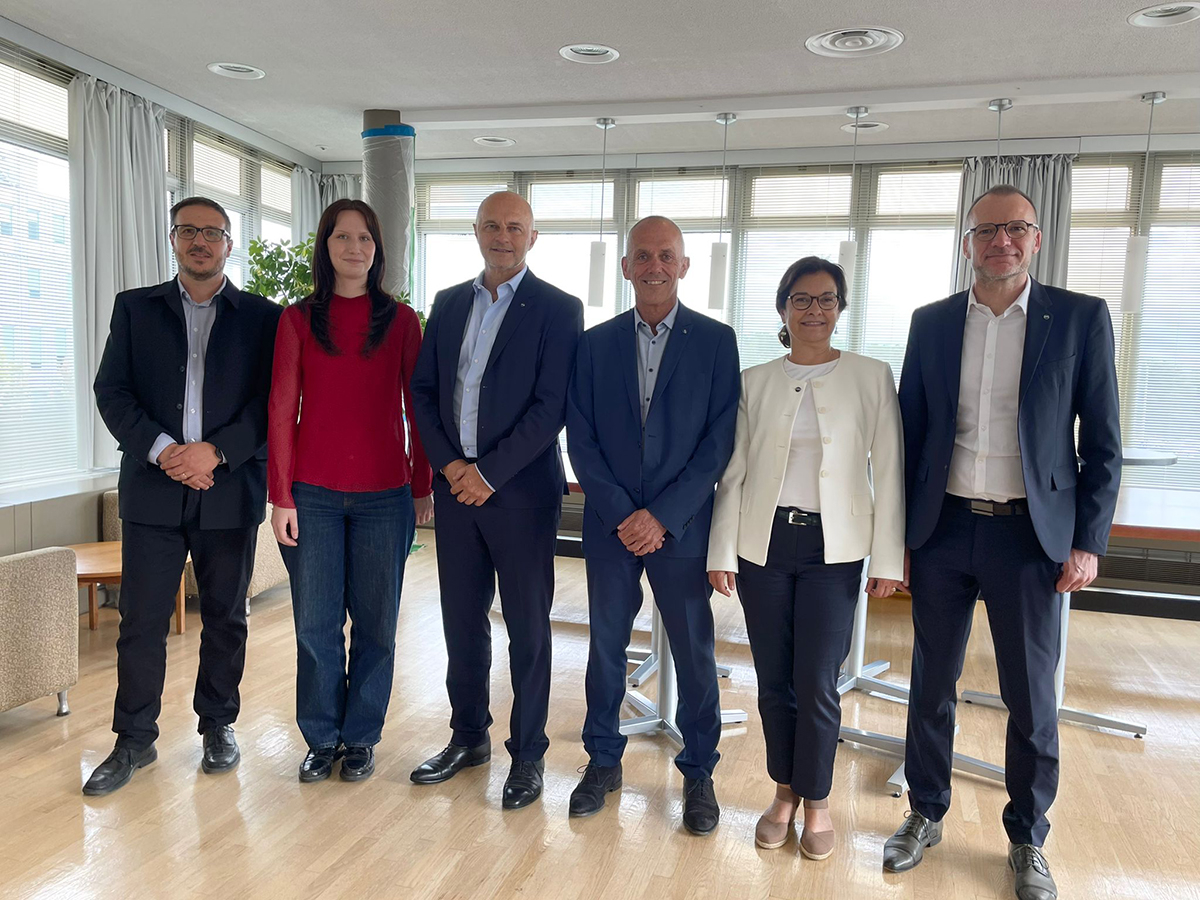
Antoine Petit, the CNRS Chairman and CEO, visited Canada at the end of August 2025. What was the purpose of his visit?
Andréa Dessen
We were also lucky enough to get a glimpse of future collaborative projects like the 'PhD Joint Programme'
In the same way as the CNRS's cooperation with the UdeS, international collaboration initiatives with CNRS partners have multiplied in Canada since the Ottawa office opened in 2022. How would you explain this dynamic?
A. D.: The CNRS has indeed been very much welcomed by local scientific institutions. This positive and exciting dynamic is particularly evident if we look at the number of co-publications between the CNRS and its Canadian partners. Between 2020 and 2024, there have been over 12,000 such publications which breaks down to approximately 2400 each year. These figures are still rising and make the CNRS the third largest international partner of Canadian institutions while Canada ranks fourth among our organisation's non-European partners.
Beyond statistics like this, I can build on the solid foundations built by my predecessor Jan Matas to consolidate structured scientific relations with our Canadian partners. As a French institution, the CNRS benefits from privileged historical and diplomatic relations with Quebec, as the IRC run with the UdeS clearly shows, but our collaborations aren't limited to 'La Belle Province'. The CNRS seeks scientific excellence throughout Canada but we don't limit that to any one geographical area. That's why the organisation has forged special partnerships with the universities of Toronto, through a PhD Joint Programme and the Twin Research Scholars programme, and Ottawa, which hosts our national office, three international research projects and two international research networks (IRNs). The same can be said for the Pacific coast on the other side of the country where the CNRS launched a new PhD Joint Programme this year in collaboration with the University of British Columbia in Vancouver.
How do you see the prospects for the CNRS's development in Canada?
A. D.: After the launch in 2023 of the France-Canada Joint Committee (Comix) and the creation of the Canada-France Quantum Alliance (Cafqa), a thematic quantum technology network involving around 20 French and Canadian institutions, Comix 2025 has now opted to concentrate on the oceans and the poles. French expertise in this field is widely recognised, particularly that of the CNRS, the French partner of the Natural Sciences and Engineering Research Council of Canada. Cooperation on oceans and polar regions is also at the core of the work of the Takuvik IRL, a successful collaboration between the CNRS, Université Laval and the Sorbonne. This theme's global scope has led the Franco-Canadian Comix to decide to support broader cooperation within the multilateral framework of the Belmont Forum. Canada's integration into Pillar II
In other words, we'd like to make the office a welcoming place for our various Canadian partners to bolster our collaborations with Canada through the CNRS's international collaboration tools and access to more ambitious funding such as that provided by Horizon Europe. This is even more important given the current context in the United States because Canadian scientists have shown increased interest in collaborating with Europe.
As we're on that subject, how has the Canadian scientific ecosystem reacted to the White House's new attitude to science?
A. D.: Mainly by offering to welcome American students and scientists. A survey run by Nature magazine at the start of 2025 showed that 75% of American scientists were thinking about leaving their country and the European Union and Canada were among the main destinations they're considering. Indeed, major Canadian universities like Ottawa and Toronto have seen a 25% increase in applications from students and professors alike.
In Quebec, the universities of Laval, McGill, Sherbrooke and Montreal have been proactive in launching the Polaris programme for American scientists and Canadians who live in the United States. The objective of this programme is to create new research chairs in strategic areas like AI, health or biodiversity and targeted doctoral scholarships, with the overall aims being to support early-career scientists and invest in research structures. This paves the way for new cooperation opportunities for the CNRS, particularly in Western Canada, and ultimately represents an opportunity to reinforce what is already an excellent existing partnership that's highly robust.