


"Science is seen as a principle for socio-economic transformation"
Society
The fourth edition of the Critical Thinking Barometer has just been published by Universcience. The sociologist and CNRS research professor Michel Dubois details some of the key findings.
© CNRS
You are a part of the scientific committee for the Critical Thinking Barometer just published by Universcience. As a sociologist, how does your discipline inform the analysis of the barometer results?
Michel Dubois
Does this fourth edition of the Barometer reveal any noteworthy changes to the way French people use their critical thinking faculties?
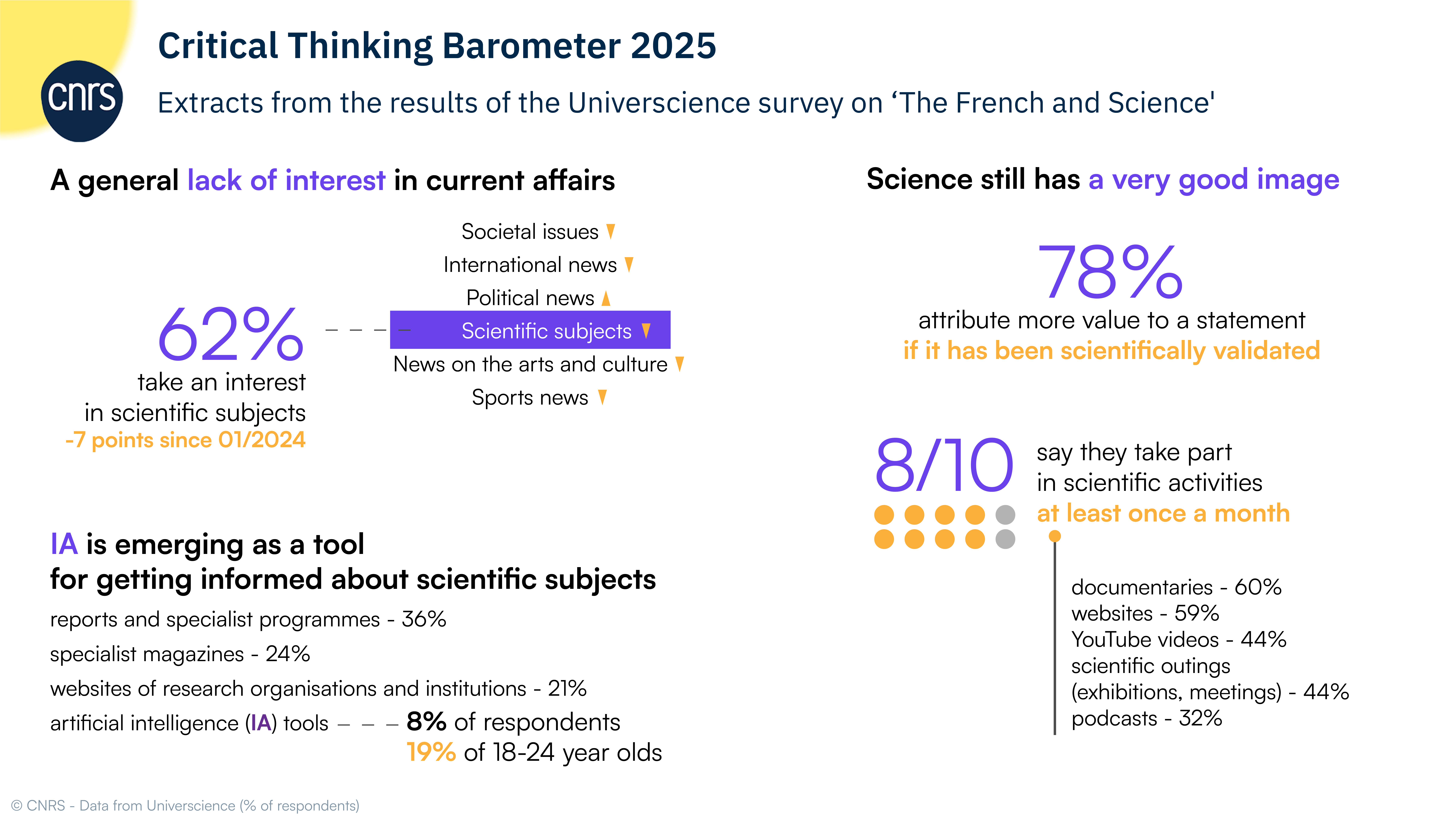
M. D.: The results of this 2025 edition confirm that science still has a very positive image in France. For example, 8 out of 10 respondents consider science makes it possible to develop new technologies that are useful for everyone or to understand more about the world we live in. This is a general observation that needs to be regularly brought to the attention of all the populist regimes openly attacking the scientific community right now.
However, this positive image of science should not be confused with understanding or mastering the research process or fundamental knowledge. Science coexists with other forms of knowledge, particularly knowledge derived from personal experience and social interaction. And from this standpoint, the section of the Barometer devoted to food practices and beliefs this year is highly interesting. When French people are asked how much they agree with a set of statements about food, 8 out of 10 agreed with at least one false statement. When asked who they trust when they need to make choices about food, they rank people they know like parents, friends or workmates as almost on a par with doctors and dieticians. People's social environment plays a very important role in defining good or bad eating habits.

The results of the 2025 barometer were presented on March 20 at the Cité des Sciences et de l'Industrie in Paris. Capture d'écran © Universcience
This year, a sample of 15-24 year-olds was added to the survey.
M. D.: Yes, that's this 4th edition's main new feature. Comparing this sample of 15-24 year-olds with the general population highlighted some unexpected or counter-intuitive results. For example, the vast majority of 15-24 year-olds (3 respondents out of 4) feel they have a critical mind but more of them than their older counterparts say they prefer to talk to people with the same opinions (+9 points) and persist in thinking the same way even if there aren't any solid arguments to back that up (+14 points). We should no doubt interpret these results in the light of what the Barometer tells us about the way this section of the population particularly obtains general information through social networks which are now the main source of information for one young person in two.
There's another unexpected result as regards younger people. Currently there's a lot of media concern about young people's growing distance from science but in fact their view of the scientific community is more positive than elder respondents. The 15-24 year-old respondents have more confidence in the independence of scientists (+13 points) and their ability to follow strict ethical rules (+9 points). Also when they're asked how they view the degree of scientific legitimacy of a given discipline, they agree with older respondents that chemistry, medicine, biology and astrophysics are exemplary sciences but really differ a lot in according greater scientific legitimacy to psychoanalysis (+5 points) and sociology (+12 points). Which is a result my colleagues in sociology will enjoy.
The CNRS plays a key role in the production and transmission of knowledge. What does the latest Barometer tell us about how scientists perceive their work? How can the CNRS learn from this?
M. D.: I observed with interest the recent CNRS initiative to organise a consultation with the open question "how can science help us to build the world of tomorrow?" The various waves of the Barometer clearly show our respondents have real expectations on this. Science is seen as a principle of socio-economic transformation and not just a collective activity that produces knowledge. And this transformation really is expected to combine scientific progress with social and economic progress. Well, our respondents think that's far from always being the case.
Whatever scientists themselves may think, citizens are increasingly saying they want to be included in defining major scientific and technological orientations. So it seems necessary to devise sustainable dialogue mechanisms centred on these major orientations. But this isn't something we can achieve at the level of just one organisation. To create the right conditions for a renewed dialogue between science and society we'd need an in-depth institutional review which the CNRS should work on with others, particularly the CNDP (French National Commission for Public Debate
People often consider critical thinking to be an individual quality. How can we encourage its collective use in institutions like the media or research?
M. D.: In science, researchers produce proof through interactions with their peers. This ‘organised scepticism’, to use the phrase coined by an American sociologist, is inherent to research. As well as knowledge dissemination, scientists have to learn to work more effectively with the media to promote the comparison of ideas, put people's misconceptions straight and share rigorous knowledge. From this angle, like other research bodies the CNRS needs to carry on working with professional associations like the French association of scientific journalists from the news press.
A rich programme of critical thinking
The 2025 Critical Thinking Barometer will be presented in the framework of the 'Spring of Critical Thinking' (in French) event from March 1st to April 30th. This initiative provides workshops, exhibitions, meetings, training courses and conferences for the general public, schoolchildren and professionals to "exercise their critical thinking and defend themselves more effectively from the mass of information". Universcience launched the event in 2022 and it is now being transposed to the national scale. Its fourth edition will focus on the theme of food.