

France 2030: launch of an upstream research programme on nuclear fission energy
Corporate
Building a decarbonized nuclear industry that is safer and more versatile is a crucial challenge for the coming years. That is why an ambitious new research programme was launched on 4 September, with a focus on the topic of Upstream Science for Nuclear Fission. It is steered by the CNRS and led by the Decarbonized Energy Programme Agency coordinated by the CEA, in keeping with a desire to accompany the energy transition. Its aim is to consolidate the scientific knowledge vital to developing current and future nuclear fission technologies. The programme is funded by the government as part of France 2030 and operated by the ANR, with a budget of 18 million euros over six years. It supports upstream research, the development of experimental infrastructure, and training for young scientists, in order to enhance the sovereignty and innovation of French research in the field.
Developing upstream nuclear research to address energy challenges
The Upstream Science for Nuclear Fission research programme is in keeping with the central goals of French energy policy: moving away from fossil energy dependence and increasing decarbonized electricity production, all while developing a more versatile, safer, and more competitive nuclear industry.
Steered by the CNRS in association with the CEA, the programme will consolidate the scientific knowledge needed to improve the performance and safety of existing installations, all while preparing the development of innovative fission technologies.
A structured programme encompassing research, infrastructure, and training
The programme is based on an upstream research approach at the intersection of basic and applied research. Its work is guided by scientific issues identified by industrial actors in the sector, all while leaving research teams freedom to explore fundamental mechanisms.
The programme will pursue three complementary goals:
Producing new fundamental knowledge (data and models);
Reinforcing the experimental infrastructure vital to this research; and
Training a new generation of scientists specializing in nuclear energy.
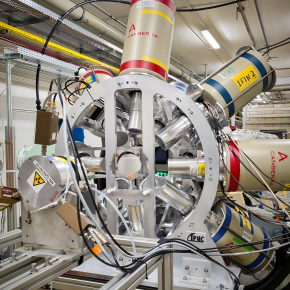
Of the 18 million euros allocated to the programme between 2026 and 2031, half will fund human resources, doctoral and postdoctoral contracts in particular, while the other half will be devoted to scientific equipment and research infrastructure, such as particle accelerators, experimental reactors, and radiochemistry laboratories.
Four research focuses to prepare the nuclear fission of the future
The programme brings together scientists from a number of core disciplines in nuclear research—nuclear physics, chemistry, radiochemistry, materials science, thermodynamics, and digital modelling—in connection with major scientific topics:
Producing fundamental data on nuclear processes to improve digital reactor models via a firmer grasp of experimental and theoretical uncertainties, in addition to testing innovative technologies.
Analysing the behaviour of corium, a mix of materials formed when a reactor core melts during an accident. Scientists will notably study its properties and interactions with water, which is used to cool reactors in accident-related situations. Thanks to innovative experimental systems, scientists will better understand this complex and highly radioactive mix, in an effort to better confine it during an accident. They will also develop realistic accident management approaches over the medium and long term (from a few weeks to a few months).
Studying the future of radioactive nuclei. Research is striving to better understand the behaviour of radionuclides¹ such as uranium and plutonium, with a view to optimising their management in both nuclear installations (fuel) and the environment.
Developing new materials that can enduringly resist the high radiation to which nuclear reactors are subject, which is indispensable to developing systems with improved performance and durability.
The knowledge produced will, among others, help improve the performance and safety of installations, optimise the management of radioactive material and waste, and support the development of innovative reactors addressing future energy needs. In general, the programme will also help maintain France’s position among global leaders in nuclear research.
Regarding the France 2030 Investment Plan
Reflects a dual ambition: to lastingly transform key sectors of our economy (health, energy, automobile, aeronautics, and space) through technological innovation, and position France not just as an actor but as a leader in the world of the future. France 2030 supports the entire innovation life cycle up through industrialisation, from basic research and the emergence of an idea to the manufacturing of a new product or service.
It is unprecedented in scope: 54€ billion will be invested so that our enterprises, universities, and research organisations fully achieve their transition in these strategic sectors. The goal is to help them competitively address the environmental and attractiveness challenges of the coming world, and to promote the emergence of future leaders in our sectors of excellence. France 2030 is defined by two transversal goals in which 50% of its spending is devoted to the decarbonisation of the economy, and 50% to emerging actors driving innovation with no unfavourable environmental costs (in the sense of the Do No Significant Harm principle).
Is collectively implemented: it is conceived and deployed in conjunction with local and European economic and academic actors, in order to identify strategic orientations and flagship actions. To receive government support, project leaders are invited to submit their applications as part of open, demanding, and selective procedures.
It is led by the General Secretariat for Investment on behalf of the Prime Minister, and is implemented by the French Agency for Ecological Transition (ADEME), the French National Research Agency (ANR), Bpifrance, and the Banque des Territoires.
More information is available on the government website and @SGPI_avenir
Notes
- A radionuclide is an unstable atom that releases energy in the form of radiation to stabilise itself. This is the principle of radioactivity.

