
A new species of Mosasaur identified in Provence, southeastern France
Environment
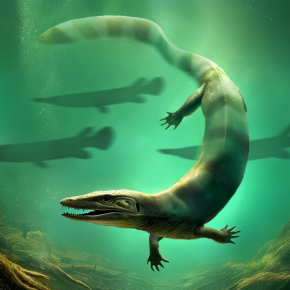
Although long regarded as exclusively marine animals, mosasaurs--large Cretaceous predators--also included freshwater species. Now, a research team led by CNRS researchers 1 has presented evidence of this with the description of a specimen that lived around 85 million years ago near present-day Aix-en-Provence (southeastern France). Discovered in a lacustrine environment, this 2.5-metre-long mosasaur has mixed morphological characteristics, both terrestrial and aquatic, suggesting that a branch of these predators adapted to terrestrial freshwater environments. Their findings are published on 28 September in PCI Paleontology.
Unlike open-sea mosasaurs, which had paddles, analysis of the fossil remains shows that this individual instead had limbs similar to those of land animals. However, several features, particularly its exceptionally dense bones, indicate an aquatic lifestyle. Such bone density, which helps counteract buoyancy2, is an adaptation incompatible with terrestrial locomotion. It probably helped the animal to remain submerged while moving through shallow waters. Moreover, the presence, in the same deposit, of fossils of freshwater species, particularly certain molluscs, lends weight to the hypothesis that this specimen was confined to a lacustrine environment.
From an evolutionary perspective, the discovery reveals a previously little-known ecological diversification among mosasaurs. While these predators are known to have been dominant in the oceans of the Late Cretaceous3, the identification of a new freshwater mosasaur from this period suggests that at least one lineage may have taken a different path by extensively colonising lakes and rivers, indicating a far more complex evolutionary history than previously thought.
- 1
Nathalie Bardet, CNRS researcher at the Centre de recherche en paléontologie (Centre for Research in Palaeontology), Paris (CNRS/MNHN/Sorbonne University) and Alexandra Houssaye, CNRS researcher at the laboratoire Mécanismes adaptatifs et évolution (Adaptive Mechanisms and Evolution Laboratory) (CNRS/MNHN). This work also involved scientists from the Muséum départemental du Var (Var Departmental Museum), the Muséum d'Histoire Naturelle d'Aix-en-Provence (Natural History Museum of Aix-en-Provence), and the Réserve naturelle nationale Sainte-Victoire (Sainte-Victoire National Nature Reserve).
- 2
Marine mammals and reptiles that are not adapted to swimming fast and/or at depth often have denser, more compact bones than those of land animals. This density partially counteracts buoyancy, the force exerted by water that tends to make submerged bodies float. Thanks to their denser bones, they are less buoyant, can dive more easily and remain at the desired depth, and expend less energy when moving underwater.
- 3
The Late Cretaceous is the final epoch of the Cretaceous period and lasted from 100.5 to 66 million years ago. It was characterised in particular by a high degree of diversification of dinosaurs and by their eventual extinction.
Bibliography
Garamaudo bauciensis, a new freshwater mosasaurid (Reptilia, Squamata) from the Santonian (Late Cretaceous) of Provence, southeastern. Bardet Nathalie, Houssaye Alexandra, Pelissier FrançoisLouis, Dutour Yves, Turini Eric, Tortosa Thierry. Science, September, 28th 2026.