


Research infrastructures are responding to the challenges of the environmental transition
Following the CERN's publication of the feasibility study for its Future Circular Collider (FCC) project, associations and scientific communities are now asking questions about the environmental footprint of research infrastructures of this kind. An invitation to the research sphere to advance knowledge sustainably.
The figures for the Future Circular Collider (FCC) intended to take over from the LHC at CERN by 2040 are particularly impressive. It will be almost 90 km in circumference, installed at a depth of 200 m, has a budget of 15 billion Swiss francs
Measuring the environmental footprint of research infrastructures
The case of the FCC illustrates recent questioning linked to this issue. In our era of environmental transition, energy-hungry research infrastructures and the environmental impact of building them are bringing up questions, including within scientific communities themselves. In fact, particle accelerators are not alone in this with clean rooms, data centres and certain giant telescopes also provoking controversy within their respective communities. The issue is of such importance that the Chairman and CEO of the CNRS referred the matter to the CNRS Ethics Committee in 2022, requesting them to examine the environmental impact of scientific research. The Cern has in fact been publishing annual environmental reports for nearly ten years and so is well aware of these issues, as Christelle Roy, the director of CNRS Nuclei & Particles (one of the ten CNRS institutes), explains. "Given the scale of the project, the Cern has committed to ensuring the FCC is an example of a sustainable research infrastructure and to integrating eco-design principles into every phase of the project ––– from design to construction, operation and dismantling". The 350 pages of the third volume of the FCC feasibility report set out the details of possible concepts and ideas for keeping the accelerator's environmental footprint low while driving new technologies that truly benefit society and developing local synergies in areas like the reuse of energy. Two more detailed reports are still to be published. One will look at all the project's environmental impacts, covering issues like soil, landscape, forests and agriculture, noise, air quality, traffic, topography and relief, wetlands, biodiversity, habitats, fauna and flora, and urbanisation. The second examines the FCC's carbon footprint and level of sustainability.

A study published in Nature Astronomy in September 2024 calculated the carbon impact of astronomy with indisputable results. Greenhouse gas emissions are on an upward trend which is largely due to and dominated by space missions. Extrapolation of such trends has shown a future trajectory that is incompatible with the Paris Agreement's objectives, even in the event of accelerated decarbonisation. Nicolas Arnaud, the director of CNRS Earth & Space, in no way considers such studies to be a 'slap in the face' for research – on the contrary he believes it reflects the demand for responsibility coming from the institute's own scientific community. "Even more than others perhaps, at the very least we have a duty to be coherent and set an example by making sure our actions are aligned with the knowledge we produce. Our scientific communities are stressing how important it is for them to choose a path of environmental responsibility that is both sustainable and fits their research mission which is essential to our societies". This is why Mr Arnaud's institute recently set up a network of project leaders at national level and in all its Observatories for Sciences of the Universe (OSU) tasked with calculating the carbon footprint of its laboratories and research tools and supporting researchers in reducing their environmental footprint.

Another CNRS institute currently going through a similar introspective process is CNRS Engineering. In early 2025, the institute set up a support and research unit (UAR) dedicated to life cycle analysis. This new UAR, Utopii
This issue of information granularity concerns the CNRS as a whole, beyond its ten institutes. Michel Guidal, the chairman of the organisation's TGIR (Very Large Research Infrastructures) Committee, ran a survey of research infrastructures in 2024 to find out what they were doing to calculate and cut their environmental footprint. This survey was carried out upstream of the next French roadmap on infrastructures which is scheduled to be published at the end of 2025 and will integrate a sustainable development criterion for the first time. The upcoming European roadmap will do likewise. "More than our laboratories in general, research infrastructures have a legal personality and can find considerable room for manoeuvre and a degree of autonomy to take decisions on proactive actions that have a real impact on large areas", argues Michel Guidal. "This survey's aim was to identify each infrastructure's best practices and share them via general guidelines, rather than defining a single set of rules for everyone which would be ineffective, really, because of the wide diversity of infrastructures".

Towards sustainable infrastructures
Three main ideas for infrastructure sustainability have emerged thanks to this survey and the work of the institutes. The first is the eco-design and repairability of the CNRS's instruments which is set out in the CNRS's Sustainable Development and Social Responsibility Plan. Stéphane Guillot, the CNRS's scientific officer for environmental transition and risks, argues that "every instrument needs to be eco-designed before it is built to taking its entire life cycle into account – from design to dismantling and covering operation and data use". This logic of optimising energy consumption is equally valid for reducing the environmental footprint of infrastructures as for protecting these from the current growing geopolitical risks. Mr Guillot recalls that "the war in Ukraine and the massive rise in energy prices revealed the fragility of energy-intensive infrastructures. Some were forced to shut down when the price of electricity went up". If combined with a more frugal outlook, this optimisation actually could lead to significant reductions in greenhouse gas emissions. For example, Nicolas Arnaud estimates that in astronomy "launching several satellites at the same time, increasing the duration of space missions and eco-designing our equipment upstream could help us achieve a 25% cut in the impact of very large research infrastructures". Michel Guidal adheres to this logic of scientific frugality and recommends extending the lifespan of instruments for as long as they are scientifically efficient. He believes that "if the scientific performance levels are equal then infrastructures should think carefully about whether they can repair and retool an old instrument rather than buying a new one". In this way, upgrading an infrastructure is an opportunity to rethink the choice of technologies in depth. He points to the ongoing renovation of the Soleil synchrotron as an example because it uses permanent magnets rather than electromagnets. This, he explains, is "an environmentally responsible technological choice that does not negatively affect scientific performance levels" but does cut electricity consumption by up to 40%.
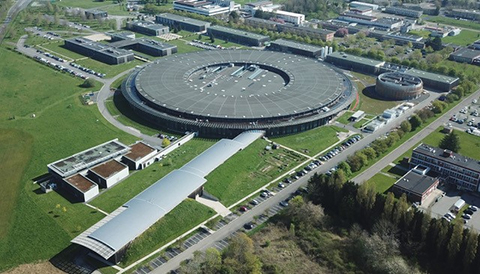
Reducing the environmental footprint of research infrastructures also needs to be based on international cooperation as well as working on individual buildings. Pooling infrastructures reduces the financial and environmental cost of building and maintaining an infrastructure while of course promoting scientific dialogue between users. This is one of the reasons the Cern was created 70 years ago, as Christelle Roy points out. "For the last 70 years, there's only been one particle accelerator in the world at the energy frontier for cutting-edge particle physics research that federates the whole community – and it's at the Cern
As well as buildings, the CNRS's scientific delegate for environmental transition and risks advocates for research data to be shared more effectively because sharing and re-using data can also reduce the environmental footprint of research infrastructures. "Scientific communities are now seeking to make better use of their data through data mining

But these representatives of the CNRS are all in full agreement on one point, namely that research infrastructures must continue to be developed. Stéphane Guillot considers them "essential for knowledge that enables us to move forward. The discoveries we're making now might be useful in twenty or thirty years' time for new applications, particularly those linked to the environmental transition". The goal now needs to be to make sure these are as sustainable as possible, as Nicolas Arnaud advocates. "We need to find the right balance between our need to push back the frontiers of knowledge to understand the world around us and the need to adapt our ways of working to this world of finite resources. However, I think science needs to be ring fenced to an extent in comparison with other activities because a society with no scientific approach and that is not built on scientific truth is a society that is losing its way".