The Year of Health: "Health issues are not limited to the notion of healthcare"
Corporate
Highlighting cutting edge science in the field of health and reinforcing the links between research and education are the dual objectives of the Year of Health, the fruit of a partnership between the CNRS and the French Ministry of National Education. Anne Siegel, the CNRS's coordinator for this initiative, discusses the ambitions of this new thematic year.
A new thematic year focusing on health is to be officially launched on October 14th 2026. What are its objectives?
Anne Siegel1: The Year of Health (Année de la Santé) is a new iteration of the ‘thematic year' concept deriving from a partnership between the CNRS and the French Ministry of National Education that has covered a variety of fields, such as chemistry (2018), mathematics (2019), biology (2021), physics (2023), geosciences (2024) and engineering (2025). The overall aim is to showcase advances in a given disciplinary field while also bolstering the links between science and education. For this new academic year, the CNRS and the Ministry have selected the theme of health and will be exploring it across all school subjects.
How can health be defined?
A. S.: We've adopted a comprehensive definition and categorised our initiatives into three main themes, namely 'Health for All', 'Improving the Health of Individuals and the Environment' and 'Innovation for Health'2. We want to demonstrate that health issues viewed from both a research and a professional perspective go far beyond the concept of medical care. We therefore cover topics like health inequalities, mental health and the links between health and the environment, including the 'One Health' approach. Based on this scope, we've naturally involved stakeholders from higher education and research who are active in this field in the Year of Health. These are the Inserm, the INRAE, the CEA, France Universités, the College of Academic Learned Societies and the APRS (Health Research Programme Agency).
Unlike the previous themes, health is not taught as a subject in schools. What challenges does this bring up?
A. S.: Previous themed years did draw on various CNRS Institutes for research but indeed focused on a limited number of school subjects, which is not the case with the Year of Health. The aim for this year is to demonstrate that health issues span a wide range of fields, from biology to the humanities and social sciences, including the technological sciences. This broad approach means we can tailor our activities to teachers of different subjects like life and earth sciences or physics, but also mathematics, computer science, philosophy, economics and social sciences, geography, and so on.
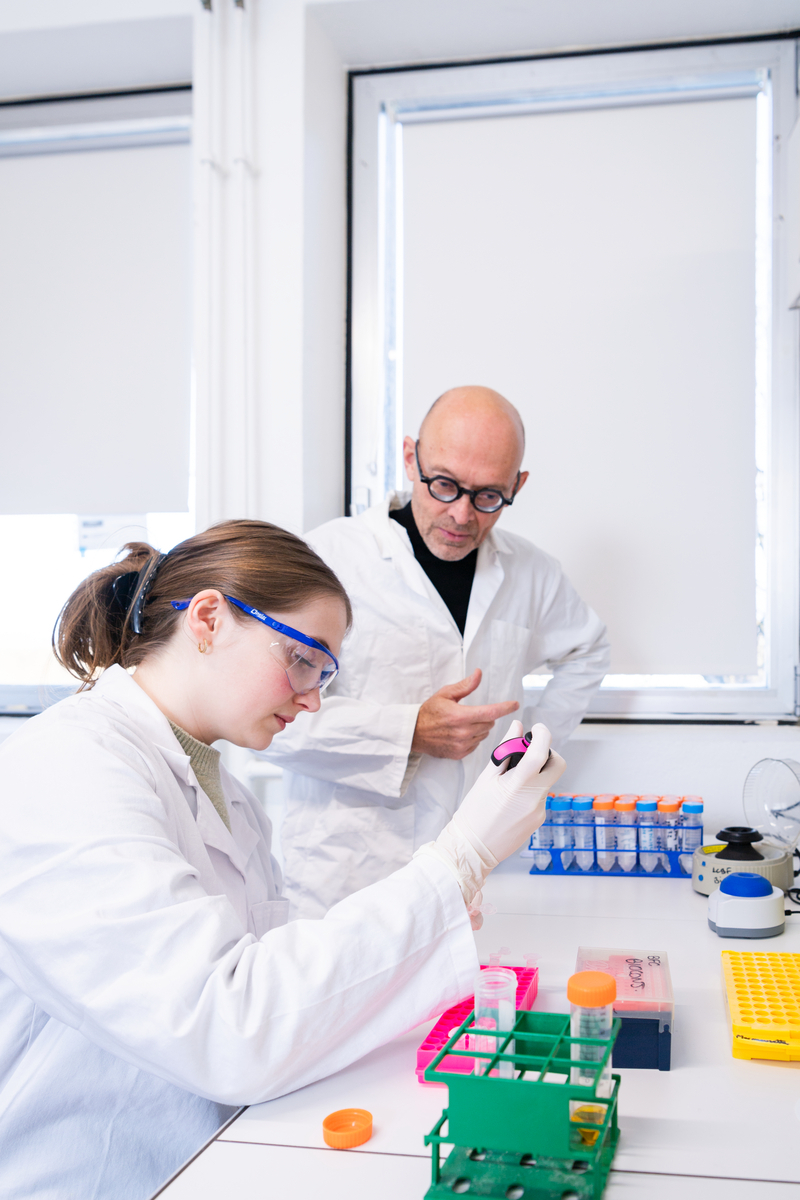
Alain Wagner, recipient of the 2025 CNRS Innovation Medal, observes the synthesis of an antibody-drug conjugate carried out by Salomé Soltner, a doctoral student in the Biofunctional Chemistry team at the Synthetic & Therapeutic Chemo-Biology Laboratory © Cyril FRESILLON / CBST / CNRS Images
What are the CNRS's strengths in the field of health?
A. S.: The CNRS has been developing its health policy for several years, notably through its 2024 health roadmap. In fact, our mapping work found that around half of the CNRS's laboratories work on health-related issues. The basic research carried out in these labs can indeed be applied to health-related issues, which creates new challenges and promotes the development of virtuous circles. For example, robotics research can lead to advances that improve the independence of the disabled. This model forms a continuum between basic research in a discipline and health research within our laboratories and is one of the CNRS's major strengths.
How can the latest advances in basic research be communicated in an educational context?
A. S.: I'm convinced that the best way to communicate on this is to make our audience's eyes light up, which is the aim of our 'Intertwined Stories of Science and Health'1 programme which takes the form of lectures aimed at teachers. We've enlisted scientific ambassadors to construct these stories from multiple standpoints, spanning biology and history, engineering and sociology, mathematics and geograph and so on. The topics to be covered are highly varied and include the history of the anti-malarial drug artemisinin, issues surrounding vaccination, and challenges linked to using medical imaging to diagnose breast cancer. These stories will help teachers and pupils alike to engage with the latest research advances.
So, what are the key current issues for science in the field of health?
A. S.: One key challenge is to improve prevention, which involves understanding the reciprocal interactions between the various determinants of health throughout a person's life to anticipate and address risks. The second challenge is to innovate to diagnose, make prognoses, treat patients, minimise long-term effects and facilitate recovery. The third is to tailor care to make it more effective and reduce side effects. Also, there's a cross-cutting objective that involves providing the keys to understanding and putting forward solutions to support all stakeholders in the healthcare system (individuals, family members, carers, healthcare professionals) and decision-makers in the process of continuous improvement of the healthcare pathway.
The CNRS is at the forefront on all these subjects, particularly through the Priority Research Programmes and Equipments (PEPRs)2, which the organisation either leads alone or jointly. For example, this is the case for organoids and organs-on-a-chip for subjects like modelling diseases and predicting their responses to treatment, robotics and autonomous systems, digital health or personalised medicine.
- 1
'Récits croisés en science de santé'.
- 2
The Priority Research Programmes and Facilities (PEPR) were launched in the framework of the France 2030 national recovery plan to strengthen the position of French research in scientific fields considered crucial to technological, economic, societal, health and environmental transformations.
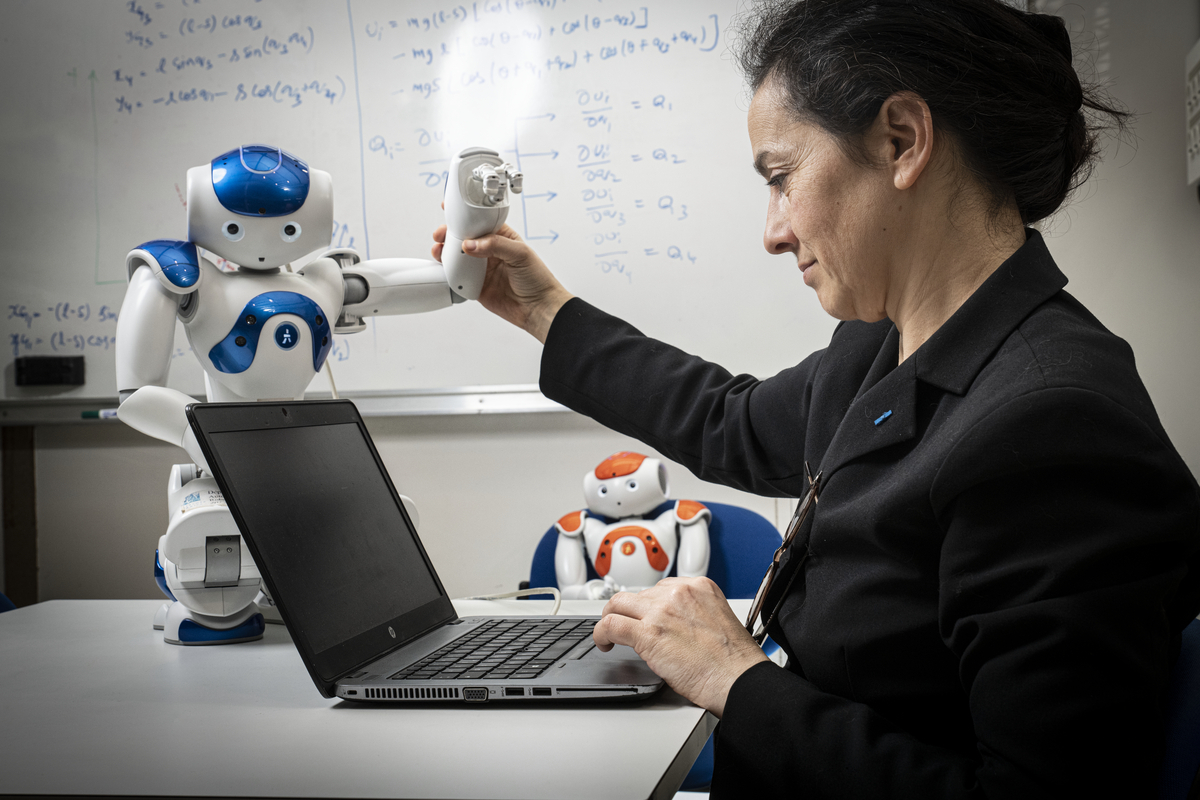
Programming a Nao robot (SoftBank Robotics) used as part of the Rob’Autisme program. This program, designed for adolescents with autism spectrum disorder (ASD), offers therapeutic support based on robotic, cultural, and artistic intervention © Jean-Claude MOSCHETTI / LS2N / CNRS Images
One of this themed year's objectives is to change perceptions of healthcare-related careers. What preconceptions might pupils come up against during careers advice activities and how can these be overcome?
A. S.: This is one of the most complex challenges for the Year of Health. Firstly, we want to stress that healthcare careers are not limited to patient care. Secondly, for a lot of healthcare-related career paths, there's no obvious link between the course of study and the intended profession. For example, to become an epidemiologist, you need to study mathematics and computer science. I believe the issue of identifying suitable training pathways is crucial. Finally, certain study courses suffer from a reputation for being complex or inaccessible, particularly among young women. If we can ensure that those who'd like to work in healthcare feel confident studying computer science, physics or mathematics, then we'll have succeeded.
The Year of Health is part of the 'Health-Promoting Schools'1 initiative. What is this initiative and what are you implementing in this framework?
A. S.: This initiative is a strategy developed by the French Ministry of Education to reduce social inequalities in health. It's a holistic approach involving education, prevention and protection that's backed up by international research data and based on a network of academic teams set up in 2020. It aims to make schools a space for pupils' personal development by reinforcing their ability to make the right choices to benefit their health. In the framework of the Year of Health, our discussions with the Ministries of Education, Health, and Research led us to reconsider the presentation of our scientific focus areas. For example, we wanted to work on disability and we redefined this to put greater emphasis on the concept of independence. The key challenge is to portray advances in health research as a desirable future and move beyond a formulation of our research questions that might be a little heavy-handed.
What activities are you planning throughout the thematic year?
A. S.: One of our flagship initiatives is the Year of Health website which already outlines our scientific focus areas. This site will showcase all the events being organised across France's academic districts along with a wealth of educational resources, with over 400 already available in subjects ranging from life sciences to philosophy. The site will also link up researchers with schools to organise meetings or lab visits. At the national level, the launch day will take place on October 14th 2026 at the Cité Internationale Universitaire in Paris. One of the event's key features will be a 'Health Village' that brings together associations, start-ups and major research initiatives like the PEPRs I mentioned earlier. More generally, the Year of Health will be a success if all the stakeholders actually embrace this concept so that's what we'll be working towards throughout the year!
- 1
École promotrice de santé'.

“Sports and Health” is one of the 15 thematic areas of the Year of Health © Cyril FRESILLON / ISM / CNRS Images