
The CNRS is accelerating its transition towards digital sovereignty
Corporate
In a context of strategic and financial vulnerability driven by dependence on non-European digital tools, the CNRS is seeking to bolster its sovereignty. The migration of several key applications and an ongoing close collaboration with the Interministerial Directorate for Digital Affairs are underway.
On June 12th 2026, the US government ordered the company Anthropic to cut access to its Mythos 5 and Fable 5 AI models for reasons of national security, a unilateral decision that sent shockwaves around the world. “Current events show that our dependence on non-European digital tools is critical”, comments Marie-Pierre Fontanel, the CNRS’s Information Systems Director.
Strategic vulnerability
American digital tools like servers and cloud services, email and videoconferencing clients, databases or collaborative applications are ubiquitous, particularly those of the GAFAM [1], as are, increasingly, Chinese tools. This is an issue for individuals but also for national research organisations like the CNRS.
These organisations have recently realised that this kind of dependence goes hand in hand with multiple vulnerabilities because hosting scientific and administrative data in a cloud outside the European Union exposes them to the risk of sensitive information leaks. The cost of the different applications is also something of a burden on an organisation’s finances. “The videoconferencing tool Zoom on its own was costing the CNRS 400,000 euros a year”, explains Marie-Pierre Fontanel. “Terminating our outsourced hosting contract for Microsoft Exchange email and replacing it with a free email service operated by our partner Renater represents a saving of 20 million euros over six years”. This is, of course, a compelling argument in a context of budgetary constraints.

© Glenn Carstens-Peters / Unsplash
These factors are driving the CNRS to prioritise moving away from GAFAM tools. At national level, this strategic objective is embodied by France’s Interministerial Directorate for Digital Affairs (DINUM). Stéphanie Schaer, the DINUM’s director at the time of writing, explains the objectives. “We’re developing the government’s digital strategy and steering its implementation to work towards increasing the efficiency of civil servants and bolstering our sovereignty”.
Videoconferencing, messaging, AI: the transition is already underway
The transition has been underway at the CNRS since early 2025 after an assessment phase that started towards the end of 2024. Among the first changes is the switch from Zoom to the LaSuite suite of software developed by France’s Interministerial Directorate for Digital Affairs (DINUM). Staff members can now communicate via the Tchap instant messaging service or use Visio to make video calls. “The DINUM has entered the field of everyday office software to enable civil servants to work with collaborative tools efficiently within a controlled and secure environment”, explains Stéphanie Schaer. Today, Tchap has more than 800,000 registered users across the French civil service, including 400,000 regular users.
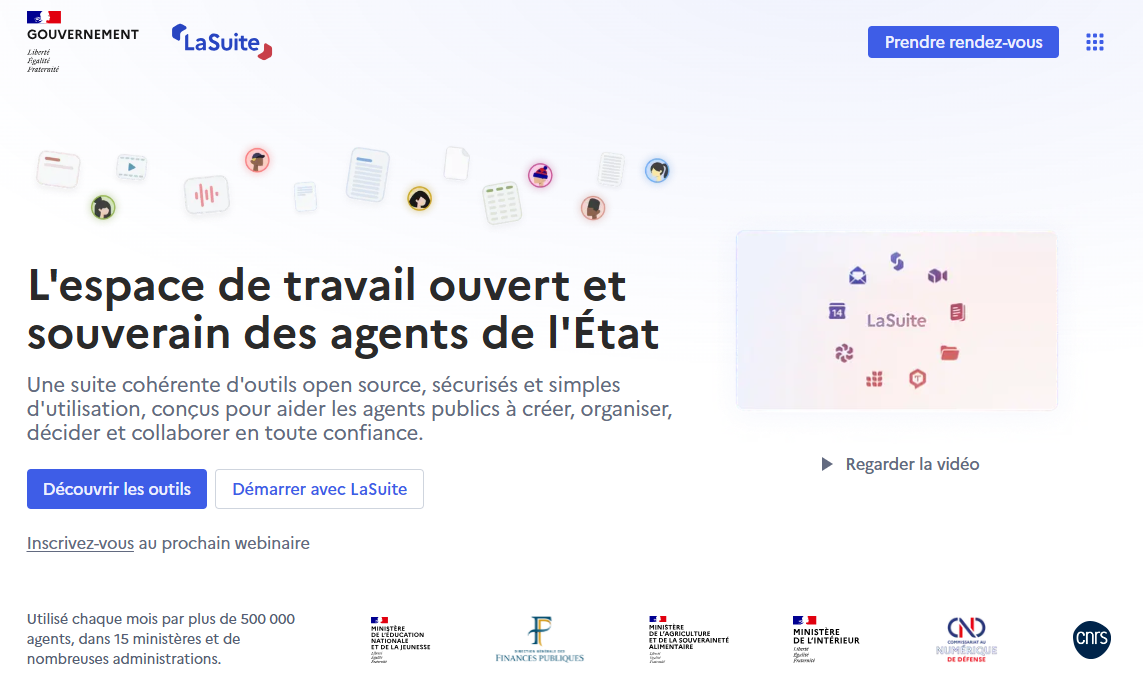
LaSuite’s tools, developed by DINUM, enable civil servants to work in a controlled and secure environment© DINUM
In April 2026, the CNRS also moved away from Microsoft Exchange for its email system, switching to Renater’s open-source Zimbra solution. “The migration process was not easy for staff members because of a still suboptimal user experience and technical issues with Microsoft’s Outlook client that we had been unable to foresee. There were also issues with the stability of the email platform, which are now behind us”, comments Marie-Pierre Fontanel. “This transition shows just how crucial it is to support staff members, so the teams in our Regional Offices were therefore heavily involved”. The Information Systems Director highlights the positive impact of this migration, explaining that “moving away from Microsoft Exchange enables us to reduce our dependence, make savings and reinforce our organisation’s cyber security”.
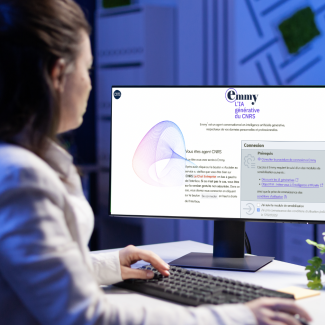
Another major challenge is generative artificial intelligence, which is used to assist staff members with their everyday tasks. “American and Chinese models currently dominate the market and we have no control over our data with these, so the CNRS has opted for a solution in partnership with the French company Mistral AI”, explains Marie-Pierre Fontanel. This solution, CNRS-Emmy, has been available to staff members since December 2025 and now has over 13,000 regular users. The field of AI is also being explored by the DINUM, which recently expanded access to its ‘Assistant’ tool also developed in collaboration with Mistral AI. “The State has a role to play in driving industrial development, particularly through public procurement”, argues Stéphanie Schaer.
Listening to users
What projects lie ahead? “Our next major milestone is the end of 2029, when we start phasing out the Microsoft SharePoint solution”, explains Marie-Pierre Fontanel. This Government-mandated transition follows Microsoft’s announcement that it is moving its tool to the cloud. It will affect 2000 collaborative workspaces at the CNRS, along with several applications that staff members use on a daily basis, like the CNRS’s Intranet and the DU portal for laboratory directors. “There’s currently no single tool that can replace all of SharePoint’s features”, notes the CNRS’s Information Systems Director but “we’re carrying out in-depth work to identify internal alternatives like sDrive, or tools the DINUM provides like Docs, Files or Grist”. This is therefore a major initiative, which will ultimately save 2 million euros a year.
The DINUM is also working on enhancing LaSuite. “We’re working with an iterative approach, listening to feedback from our users”, confirms Stéphanie Schaer. “For example, Visio already offers automatic transcription using AI, but with a delay, so we’re currently working to provide synchronous transcription, which will enable simultaneous subtitling and translation for improved accessibility”. There are also ongoing discussions with IT managers in ministries and service providers to make sure the tools are rolled out effectively. “I regularly meet with my counterparts, as it’s an opportunity to discuss our challenges and share best practices”, adds Marie-Pierre Fontanel. A fine programme lies ahead!